CAUTION: Fujifilm SDXC GFX/X macOS File Bug Found – Fix Coming Soon


Important notice for consumers processing FUJIFILM digital camera files using macOS
Feb.2.2022
FUJIFILM Corporation

FUJIFILM Corporation has identified a firmware incompatibility between specific X and GFX series cameras listed below. This incompatibility can result in macOS users being unable to directly access files if they were initially saved to SDXC memory cards in-camera.
To address this anomaly, Fujifilm is creating a firmware patch, which is expected to be available for free download by X Series and GFX System users soon.
In the interim, please review the following information carefully for further information and recommended next steps.

I.Firmware Incompatibility Overview

  1. X Series and GFX System Cameras Affected:
    • The models that do not depend on the firmware version
    GFX100, GFX100S, GFX50S II, X-Pro3, X-T4, X-S10, X-E4, X-T30 II and X100V
    • The models that depend on the firmware version
    GFX50S (Ver.4.00 or later), GFX50R (Ver.2.00 or later) and X-T3(Ver.3.20 or later)
  2. Memory Cards Affected: SDXC memory card
  3. Computer Operating System Affected: macOS only. The incompatibility does not affect Windows users.
  4. About the incompatibility
    While the current firmware versions allow these X and GFX series cameras to internally write and store 9,999 frames*1 to a single folder, it has been observed that if more than 4,000 files are written in-camera to a single folder on an SDXC card and directly accessed using macOS the firmware incompatibility creates two potential scenarios:
    (1) Some files on the memory card may become inaccessible if the card has been connected to the computer through an internal or external memory card reader and directly accessed using macOS.
    (2) If the memory card is not ejected correctly from a computer using macOS, there is a likelihood that data may be lost*3 if the same card is directly connected and accessed a second time using macOS. However, risk of data loss in this situation can be prevented by following proper ejection procedures*2 for macOS operating systems. If the proper procedures are followed, no data will be lost. However, files will still remain inaccessible when attempting to directly access the data on the memory card using macOS.
    *1 The number of frames, or images, does not correlate to the total number of files because one image can potentially create 3 files if the user is utilizing JPEG, RAW (RAF) and Voice Memo (WAV) in making one image.
    *2 For more information related to properly ejecting SD memory cards from macOS, please refer to the official Apple website (as of Feb. 2, 2022). The instructions are as follows:
    – Ejection process below referenced from Apple website –
    To eject an SD card, drag the icon that represents the card to the Trash.
    After the icon disappears from your desktop, you can remove the card from the slot.
    Don’t remove a card while your Mac is in sleep mode, as this could lead to data loss.
    Always wake your computer and eject the SD card before removing it from your Mac.
    *3 FUJIFILM is not responsible for any loss of use, images, files, data, or other information in connection with the use of FUJIFILM products caused by the above improper ejection procedures.

II. Addressing the firmware incompatibility
To address the incompatibility, Fujifilm is developing a firmware patch that will limit the number of files that can be written to a single folder. This patch is expected to be available for free download by X Series and GFX System users soon.
In the interim, consumers using macOS to directly access files saved to SDXC memory cards by the specific FUJIFILM X and GFX series cameras listed above are encouraged to:

  1. If using a new or recently formatted SDXC memory card:
    • Do not save files for more than 1,000 frames, in-camera, to any folder.
    • Once the number of frames reaches 1,000, create a new folder using the “Folder Selection” function in the “Set-up” menu of the camera and save additional frames to the new folder.
  2. If using an SDXC memory card with existing files or one that has not been recently formatted:
    (See the detail instruction linked here.)

    (1) Directly connect your camera to the computer operating macOS via USB to directly access your files.
    (2) If there are no movie files larger than 4GB in the folder, all files can be transferred to the computer operating macOS.
    * Please note that movie files larger than 4GB will be shown as 4.29GB on macOS regardless of its actual file size.
    (3) If there are movie files larger than 4GB in the folder, download all files except the movie files to the computer operating macOS.
    Afterwards, disconnect the USB cable from the computer and follow the procedures below.Please refer to the options below to download the movie files larger than 4GB.

[ Using a Windows computer: ]

  • Directly access the SDXC memory card from the computer operating on Windows through internal/external card reader.
  • Download those movie files of more than 4GB to the computer operating on Windows and eject the card from the reader.
  • Format SDXC card already possessed or above card with the camera.
  • Insert the formatted SDXC card to Windows computer with internal/ external card reader and copy those movie files to the memory card.
  • Insert the SDXC card which the movie files of more than 4GB are copied to the computer operating macOS with internal/ external card reader and download them.

[ Using a Dual-slot Camera: ]
Dual-slot camera: All models of GFX series cameras and X-pro3, X-T4, and X-T3

  • Put the SDXC memory card with the movie files of more than in one card slot and the one formatted card into the other card slot and copy those files to the formatted SDXC memory card.
  • Use an internal or external card reader to directly access and download the movie files to a computer operating macOS.

(4) When all files are fully downloaded from the SDXC memory card to the computer operating macOS, please format the SDXC memory card and follow the suggested guidelines from Section 1 (If using a new or recently formatted SDXC memory card).

If you do not have a Windows PC, or dual-slot camera, please contact Fujifilm Customer Service in your region.
Thank you for your understanding and for being a part of the Fujifilm community.

Mac, and macOS are trademarks of Apple Inc. in the U.S.A. and other countries.
Windows is a registered trademark of Microsoft Corporation in the U.S.A. and other countries.

Posted in Press releases| Leave a comment

Fujifilm GFX More Than Full Frame, 5 Years Of GFX Celebration Continues, and February #10YearsOfXMount Challenge


It looks like Fujifilm Nordic seems particularly excited about the GFX’s 5th anniversary since they released a More Than Full Frame campaign video and started a video series 5 Years Of GFX, which you can view below. The More Than Full Frame marketing is kind of unique and I am curious if Fujifilm Global will pick up the campaign.

Fujifilm also announced the February theme for #10YearsOfXMount all you have to do to enter is follow the directions below and post your photos on social media.

What was your first X Mount camera? How did you get into the world of X Mount?
We want to know what made you got into the X System!

Tell us your first X Mount camera you owned and show us a photo shot on the camera!
Make sure to tag your photo with #10YearsOfXMount and your photo may be featured on our official accounts!

Fujifilm has a lot of anniversary stuff happening at the moment between its 88th birthday, 10 years of X Mount, and 5 years of GFX. I for one have been shooting X mount and GFX from day one and I hope to continue for many years to come.

Fujifilm GFX100S:
B&H Photo / Amazon / Moment / Adorama
Fujifilm GFX100:
B&H Photo / Amazon / Adorama

Fujifilm GFX50SII:
B&H Photo / Amazon  / Moment / Adorama
Fujifilm GFX50R:
B&H Photo / Amazon / Adorama
Fujifilm GFX 50S:
B&H Photo / Amazon / Adorama

Follow Fujiaddict on Facebook, TwitterInstagram, and YouTube

Plus our owners’ groups
Fujifilm GFX Owners Group
Fujifilm X-H Owners Group
Fujifilm X-T Owners Group
Fujifilm X-S Owners Group
Fujifilm X-Pro Owners Group
Fujifilm X-E Owners Group
Fujifilm X-A Owners Group
Fujifilm X100 Owners Group

Posted in Fujifilm GFX, Fujifilm GFX 100, Fujifilm GFX 100 Megapixel, Fujifilm GFX 100S, Fujifilm GFX 50R, Fujifilm GFX 50S, Fujifilm GFX 50S II, Fujifilm GFX100 IR| Tagged , , , , , , , , , , , , , , , , , , , , , , , , , , , , , , , , , , , , , , , , , , , , , , , , , , , , , , , , , , , , , , , , , , | Leave a comment
Tokina SZ Super Tele Finder Listed


Tokina SZX 400mm f/8:
B&H Photo / Amazon
Tokina SZ Super Tele 500mm f/8:
B&H Photo / Amazon
Tokina SZ Super Tele Finder:
Amazon

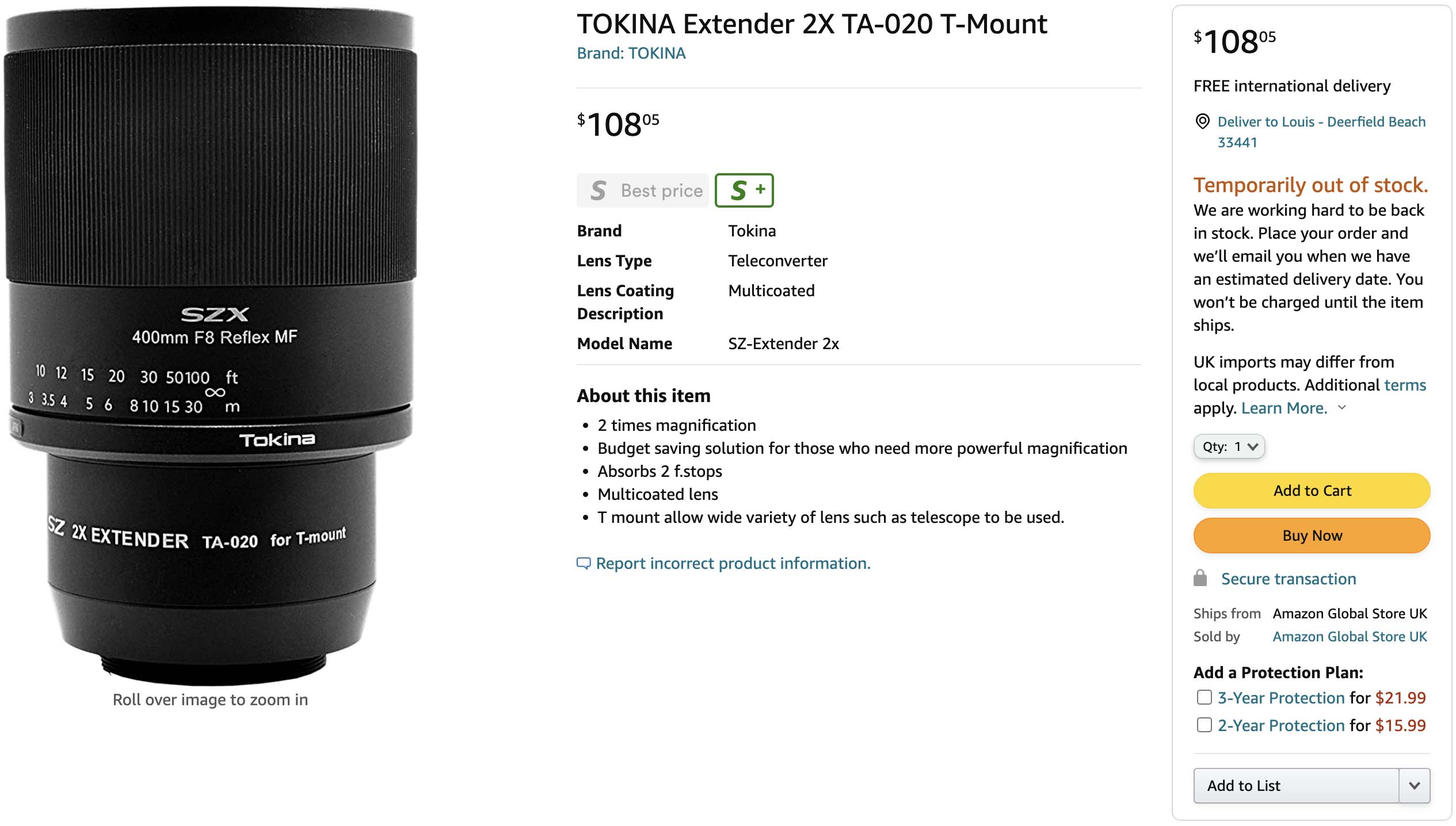
The Tokina SZ Super Tele Finder has finally been listed on Amazon, but it is shipping from Amazon UK and listed on Amazon US. I have been asked about this product quite a few times by fans of the Tokina SZX 400mm f/8 and Tokina SZX 500mm f/8.

  • Compact one-piece slim metal body and robust built
  • 10 levels of red dot brightness adjustment
  • Horizontal and vertical calibration
  • Automatic sleep mode in 3 minutes and Power Off in 5 hours
  • Tokina multi-coating for a clear red dot even in sunny weather

Description
Quick and accurate long distance aiming at objects using tele or super tele lenses is not as simple as it seems to be. A narrow field of view makes the photographer hunt for a while until the object appears inside the frame. This waste of time might cost the photographer the perfect shot. The Tokina Super Tele Finder Lens is a convenient accessory for photographers who practice long distance tele shooting like birds, celestial bodies, auto racing, fireworks, airplanes or animals. The purpose of this accessory is not just to assist in aiming but even in tracking the target in a quicker and more accurate way. Suggested to use with a tele or super tele lens like the Tokina SZX 400mm F8 Reflex; Tokina SZ Super Tele Finder Lens features a one-piece slim metal body with no moving parts. This simple design and robust built assures long life with less chance to break in tough situations, unlike other brands that uses mostly plastic materials. Tokina SZ Super Tele Finder Lens requires red dot calibration before shooting. For this purpose there are two screws for vertical and horizontal adjustments on the top and left side of the unit. Unlike other brands, adjustment screws of the Tokina SZ Super Tele Finder Lens do not come out from the surface, so the chance of accidentally shifting the adjustments is much smaller. The Tokina SZ Super Tele Finder Lens incorporates a shake sensor that detects small impacts and moves in 3 dimensions. When the unit is not in use (stays still), sleep mode will be automatically executed in 3 minutes to prevent battery power loss. Power will go OFF if the unit is not in use for 5 hours. Lens size 26 x 21mm Coating Tokina multi-coating Brightness adjustment Switch button Brightness levels 10 levels Lens light transmittance 97% Magnification 1x Weather-proof up to 2m (internal test) Power supply 1 x CR2032 coin-shaped lithum battery Main unit material Aluminium Dot color Red Warranty 2 years Country of origin Japan Weight 41.5g (Main unit only) Dimensions 56.5 x 29 x 32.5mm (Main unit only)

Posted in Accessories| Tagged , , , , , , , , , , | Leave a comment

Complete Your Kit: Fujifilm’s New Wacky Parody of The Dating Game Ad

Fujifilm released a wacky parody of the dating game on Twitter the other day with a female photographer trying to pick between the XF100-400mm, XF50-140mm, and XF200. It’s hard to tell how this ad will be received by western audiences, but it starts with a Fujifilm rep trying to help a woman who has been with her kit for a while now but is ready to put herself back out there. Then the Ad cuts to the dating game parody where she is asked what she is looking for and says she likes a lens that is specialized.

From there we are Introduced to the XF100-400mm, XF50-140mm, and XF200. Lens number one is the XF100-400mm that prides himself on being high performance and claims himself to be a super-telephoto zoom, while lens number two the XF50-140mm is a certified workhorse with no time for dilly-dallying and is fast and direct. Finally lens number three the XF200 is introduced as making subjects feel larger than life with a keen eye for beauty. They all enjoy nature photography and being stored in cool dry places, action sports, and the XF200 is packing a 1.4x teleconverter.

Of course, she ends up picking lens number three the XF200mm f/2, but I’m curious how this Ad will be received. The Ad ends with Fujinon XF200mm f/2 what you’re really looking for which is fine, but the format is unique, to say the least. So far the Ad doesn’t seem to have been posted anywhere except for Twitter. These kinds of dating shows are still popular today, but the entire presentation feels a little off-color to me and left me wondering who is Fujifilm really targeting with this Ad, or are they just trying to be controversial and maybe go viral? Would they make the same Ad with a Male? What do you think?

Fujinon XF 200mm f/2 OIS WR w XF 1.4x TC F2 WR:
B&H Photo / Amazon / Adorama
Fujinon XF 100-400mm f/4.5-5.6 R LM OIS WR:
B&H Photo / Amazon / Moment / Adorama
Fujinon XF 50-140mm F2.8 R LM WR:
B&H Photo /Amazon / Adorama

Posted in Fuji lenses| Tagged , , , , , , , , , , , , , , , , , , , , , , , , , , , | Leave a comment

Fujifilm GFX100S In Stock! Only 2 Available So Don’t Delay


The Fujifilm GFX100S has been hard to find since launch, but there are two currently in stock at shopmoment so don’t miss out!

Fujifilm GFX100S:
B&H Photo / Amazon / Moment / Adorama
Fujifilm GFX100:
B&H Photo / Amazon / Adorama

Fujifilm GFX50SII:
B&H Photo / Amazon  / Moment / Adorama
Fujifilm GFX50R:
B&H Photo / Amazon / Adorama
Fujifilm GFX 50S:
B&H Photo / Amazon / Adorama

Follow Fujiaddict on Facebook, TwitterInstagram, and YouTube

Plus our owners’ groups
Fujifilm GFX Owners Group
Fujifilm X-H Owners Group
Fujifilm X-T Owners Group
Fujifilm X-S Owners Group
Fujifilm X-Pro Owners Group
Fujifilm X-E Owners Group
Fujifilm X-A Owners Group
Fujifilm X100 Owners Group

Posted in Fujifilm GFX 100S| Leave a comment

Fujifilm Secret Development Story: XC, XF, and GF Lenses Discussed

Fujifilm released secret development stories 1 and 2 covering XC, XF, and GF design. Story 1 also includes industrial lens products, but I excluded them from the summary below because the Japanese to English translation is particularly bad. Still, there are some interesting things to be learned below like why Fujifilm is removing OIS switches from its lenses. Apparently, it’s better if your camera determines when OIS should be turned on or off.

Part 1

  • Computers dramatically speed up and improved optical designs
  • XF lenses are designed for a high level of performance for autofocus and OIS
  • XC lenses are compact and designed for casual users that emphasize cost performance
  • XC are good kit lenses
  • Fujifilm is different in that they do not compromise image quality for their entry-level XC lenses
  • If you compromise image quality then you can fail to impress
  • XC lenses are a little darker than normal XF lenses which makes it easier to reduce the diameter of the lens in addition to using less glass and making it easier to correct for various aberrations
  • ASPH glass lenses are very expensive but can be replaced with plastics
  • Using plastics helps to make XC lenses lightweight and helps reduce costs
  • Light weight lenses can also use cheaper stepping motors
  • XC lenses cost about $100 to make
  • GF lenses are designed to cover a surface area 1.7x the size of full-frame
  • If you double the surface area a lens covers then you have to double the size
  • Aspherical surfaces and ED elements help to reduce the size of GF lenses and allow the lens to be closer to the sensor
  • Without modern lens design GF lenses would be 4 to 8x bigger

Part 2

  • Red badge lenses are high-performance lenses with high-speed autofocus that are heat, dust, and water-resistant.
  • Red Badge lenses represent Fujifilm’s best technology at the time
  • The first XF lenses to get a red badge were f/2.8 zoom lenses
  • The f/2.8 zooms  were followed by the XF 100-400mm since Fujifilm decided that red badge didn’t have to be f/2.8
  • Red badge represents flagship products
  • Then came the XF200mm f/2 and it is an extraordinary lens that was designed to work very well with all forms of autofocus
  • The XF50mm f/1 was designed to provide smooth bokeh
  • The XF18,23,33 f/1.4 were then released and designed for high resolution
  • Fujifilm designs each lens with different characteristics to suite the purpose of the lens
  • Fujifilm’s lens labels are R for aperture ring, LM for linear motor, OIS for optical image stabilization, and WR for weather and dust resistant
  • Autofocus speed is getting faster and faster
  • Fujifilm also uses stepping motors, DC motors, etc…  in their lenses
  • There is a lot to think about when picking a motor because it can have to move a lot of glass and vibration can be an issue
  • Linear motors are great because you can remove gears from the process which reduces vibration and adds speed, but it is a more delicate motor that isn’t great for heavy glass
  • To work around chattering Fujifilm places the heaviest lens in the middle of their optical designs and then balances the motor or motors around the lens
  • Fujifilm removed the OIS on/off switches because the old understanding of turning OIS off when shooting on a tripod isn’t accurate and Fujifilm has designed its cameras to decide when to turn on and off OIS on its own

Follow Fujiaddict on Facebook, TwitterInstagram, and YouTube

Plus our owners’ groups
Fujifilm GFX Owners Group
Fujifilm X-H Owners Group
Fujifilm X-T Owners Group
Fujifilm X-S Owners Group
Fujifilm X-Pro Owners Group
Fujifilm X-E Owners Group
Fujifilm X-A Owners Group
Fujifilm X100 Owners Group

Posted in Fuji lenses| Leave a comment