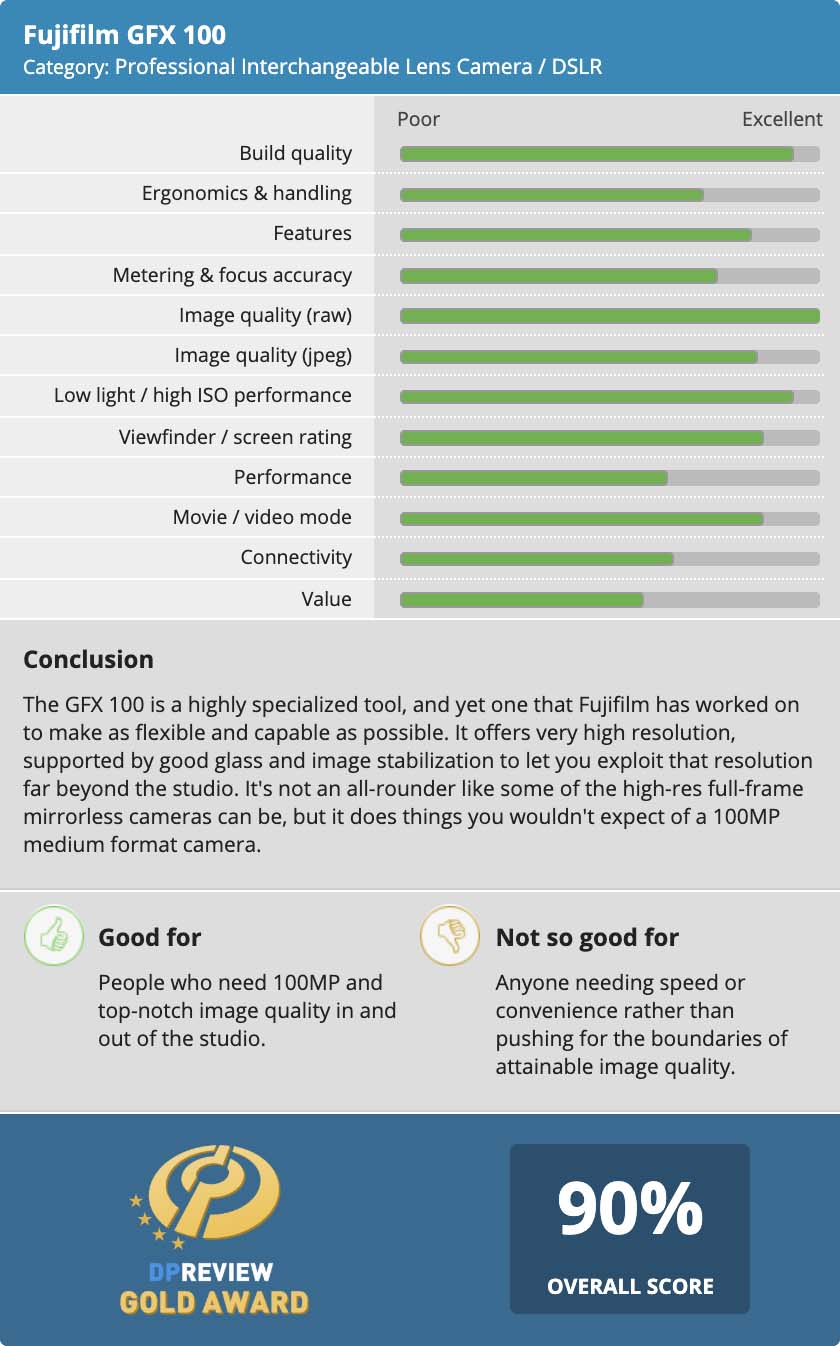
DPR: Fujifilm GFX100 Takes Home The Gold By Significantly Outperforming Full Frame Cameras


It’s not surprising, but the Fujifilm GFX100 took home the gold in DPReview’s review. You can read the full review here, but if you just want the high lights I have posted them below:

From the point of view of image quality alone, the GFX 100 is the best camera we’ve ever reviewed (though its larger sensor 150MP peers should out-perform it). The new BSI sensor and higher pixel count of the GFX 100 puts clear water between it and even the best smaller sensor cameras, and if you need the kind of detail that the GFX 100 offers, there’s no more affordable way to get it. On top of this, its in-body stabilization, autofocus performance and well-designed user interface make it significantly more flexible (and usable) than other medium format competitors.

DPReview editors also had lots of praise for the king of mirrorless cameras:

The Fujifilm GFX 100 is among the finest cameras I’ve ever used. It comes with absurdly good image quality and resolution, and yet, in most respects it responds like Fujifilm’s X-series APS-C cameras. Would I photograph an entire wedding with one? Because of its bulk and large file sizes, perhaps not. But could I photograph an entire wedding with one? Absolutely. And that is something I never thought I’d be able to say about a camera with a larger-than-full-frame sensor. – Carey Rose Reviews Editor

and

The GFX 100 is the first medium format camera I’ve ever used – film or digital – which doesn’t feel like a compromise. In almost all respects, the GFX 100 handles like a professional DSLR, but with all of the benefits of mirrorless, plus excellent 4K video capabilities and the unimpeachable image quality offered by a cutting-edge sensor. It’s not perfect, and it’s not cheap, but if I was a working professional photographer I’d buy a GFX 100 in a heartbeat. -Barney Britton Senior Editor

Finally, nothing quite compares to the GFX100 today and finally a major publication is saying it “the GFX 100 significantly outperforms full-frame camera“:

Having said that the GFX 100 significantly outperforms full frame cameras, we should still consider the Panasonic Lumix DC-S1R, since it’s able to shoot and combine multiple shots in order to offer resolution and light capture (and hence tonal quality) comparable to a larger sensor. But, while it does so in a smaller, lighter body and doesn’t have any phase detection elements to limit its usable dynamic range, its multi-shot mode only gets its best results when tripod-mounted, and applied to static subjects (and its use of electronic shutter limits its use with strobes). For most high-res applications, the GFX is the simpler, stronger, and yes, more expensive option.

What we likeWhat we don’t
  • Stunning images in terms of both resolution and tonal quality
  • Image stabilization makes it easier to get full benefit of 100MP resolution
  • GF lenses live up to the resolution demands
  • Autofocus is swift and accurate by medium format standards
  • Impressive video quality and specifications
  • Viewfinder is highly detailed and compatible with existing tilt/articulation accessory
  • Twin batteries give solid ‘in the field’ endurance
  • Chargeable/operable over USB
  • Control dials feel small and cheap
  • Autofocus performance isn’t impressive compared to smaller format cameras
  • Portrait orientation grip is slim and slippery
  • Portrait orientation controls don’t mimic normal orientation layout
  • On-sensor AF causes banding, slightly limiting usable dynamic range
  • We found it hard to find a dial setup that worked smoothly

Follow Fujiaddict on Facebook, TwitterInstagram, and YouTube

Fujifilm GFX News, Rumors, and Collaboration
Fujifilm GFX Owners Group
Fujifilm GFX Page
Fujifilm GFX100: B&H Photo / Amazon / Adorama

Posted in Fujifilm GFX, Fujifilm GFX 100, Fujifilm GFX 100 Megapixel, Fujifilm GFX 100S| Tagged , , , , , , , , , , , , , , , , , , , , , , , , , , , , , , , , , , , , , , , , , , , , , , , | Leave a comment

Free Fujifilm GFX100 Warranty Extension For Those Affected by Side Shutter Release “Lock” Defect


My shutter lock broke last week while walking around Miami for my Laowa 17mm f/4 GFX Zero-D review (I didn’t really use it), so I contacted Fujifilm and received some good news. Those affected by the Side Shutter Release “Lock” Defect will have the warranty of their camera extended to two years. Fujifilm hasn’t exactly worked out how this will happen, but according to FPS:

The extended warranty will be applied to the affected GFX 100 cameras that are being sent in. We will send you an extended warranty or it will be added to your registration. They haven’t made the decision yet.

This is very good news for those affected, but I think a camera at this price point should come with a 2-3 year warranty, to begin with. I have a lot of thoughts about the Fujifilm GFX100 that I will be sharing soon, but in the meantime, if you have any questions about the GFX100 shutter release problem feel free to contact Fujifilm at 1-800-659-3854.

Follow Fujiaddict on Facebook, TwitterInstagram, and YouTube

Fujifilm GFX News, Rumors, and Collaboration
Fujifilm GFX Owners Group
Fujifilm GFX Page

Fujifilm GFX100: B&H Photo / Amazon / Adorama

Notification Regarding Potential Loosening of FUJIFILM GFX100 Side Shutter Release “Lock” Function (Vertical grip control lock)

Posted in Fujifilm GFX, Fujifilm GFX 100, Fujifilm GFX 100 Megapixel, Fujifilm GFX 100S| Tagged , , , , , , , , , , , , , , , , , , , , , , , , , , , , , , , , , , , , , , , , , , , , , , , , , , , , , , , , , , , , , , , , , , , , , , , | Leave a comment

Fujifilm Announces Second Quarter 2019 Fujifilm Masterpiece Award Winners


Fujifilm Announces Second Quarter 2019 Fujifilm Masterpiece Award Winners
August 5, 2019, Valhalla, New York – FUJIFILM North America Corporation is excited to announce the second quarter 2019 winners of the FUJIFILM Masterpiece Award for photographic excellence at the Professional Photographers of America (PPA) affiliate print image competitions. This award is administered by state and regional affiliates of the PPA exclusively for the members of these organizations in the United States, Canada and Mexico.

The FUJIFILM Masterpiece Award is the highest honor given in connection with the PPA image competitions by Fujifilm. The award is given for images in three separate categories–Wedding, Portrait and Illustrative–that reflect the highest level of professional photography. Only photographic images with scores above 80 (out of 100) meet the criteria for the award.

The following photographers have been awarded the FUJIFILM Masterpiece Award for Q2 2019, via their local chapters of the PPA:

Northeast District:
● Aaron Beale, of A.R. Beale Photography, Enola, Pennsylvania, is a member of PPA of Pennsylvania. His image, “The Trapper”, earned a score of 82 and was printed on FUJICOLOR Crystal Archive Digital Pearl Paper by Bay Photo of Scotts Valley, California.

Southeast District:
● Constance Sanders, of Constance Sanders Photography, Bellevue, Kentucky, is a member of the Kentucky PPA. Constance’s image, “I’m All Ears”, earned a score of 80, and was printed on FUJICOLOR Crystal Archive Professional Paper Super Type CN by American Color Imaging of Cedar Rapids, Iowa.
● Suzanne Deaton, of Suzanne Deaton Photography, Hazard, Kentucky, is also a member of the Kentucky PPA.  Suzanne’s image, “Rapunzel’s Curse”, earned a score of 96 and was printed on FUJICOLOR Crystal Archive Professional Paper Super Type CN by American Color Imaging of Cedar Falls, Iowa.

Western District:
● Chris Wooley, of Heads and Tails Photography, Spokane, Washington, is a member of PPA of Washington. His image, “The Colorization of George B. Miles – 1891”, earned a score of 85 and was printed on FUJICOLOR Crystal Archive Digital Pearl Paper by American Color Imaging of Cedar Falls, Iowa.
● Jenni Knezovich, of Fotos by Jenni, Rock Springs, Wyoming, is a member of the Wyoming PPA. Her images, “Lady in Red”, and “Teensy Kittles”, earned scores of 80 and 84 respectively, and were printed on FUJICOLOR Crystal Archive Professional Paper Super Type CN by American Color Imaging of Cedar Falls, Iowa.

Fujifilm is proud to honor photographers who strive to create images of excellence and distinction with this award and to work with PPA to recognize these incredibly distinguished professionals.

Posted in Press releases| Leave a comment

DPRTV: Is the Fujifilm GFX100 Good For Professional Video? YES! But…

DPReview posted the second half of their Fujifilm GFX100 Review “Is the Fujifilm GFX100 Good For Video?” and it’s a brief but good one. If you do not have time or the ability to watch it there are excerpts below:

  • Filmed in 4K 24p 10-bit 4:2:0 H.265 200Mbps Eterna
  • Shocked to see 10-bit in a medium format cameras
  • 10-bit works with 4k 30p and 24p and 1080 up to 60p
  • No 4k 60p or 1080 120p
  • This is not a high-speed camera though because the large sensor prevents the frame rates
  • IBIS works well for video but it goes from smooth to a little clicky sometimes especially when panning
  • AF works well especially at smaller apertures
  • When using the 110mm f/2 it can smoothly shift between larger steps, which can be jarring
  • The 110mm f/2 doesn’t have jarring shifts when stopped down
  • Eterna is fantastic and gives some flexibility for editing
  • If you need more flexibility than Eterna use F-Log 10-bit
  • It’s great that Fujifilm has a standard and Eterna LUT
  • There is also HLG, but Jordan finds it to be pretty much the same as F-Log
  • HLG is nice to work with and has a big dynamic range
  • The 102MP sensor is huge and 4k only requires 8 megapixels
  • The GFX100 uses the entire horizontal width of the sensor and crops off some on the top and bottom which gives you the same field of view as photography
  • Pixel binning and line-skipping are used to produce 4k video
  • There is some rolling shutter, but not as bad as the electronic shutter when taking a photo
  • The rolling shutter will only be an issue if the camera is bouncing around
  • Low light performance is very good, but APS-C and Full Frame are also very good today
  • Medium format cameras also have slower glass than APS-C and Full Frame so there isn’t a big advantage with low light
  • Even with 10-bit Jourdan would say dynamic range for video is identical between the Fujifilm X-T3/X-T30 and GFX100
  • If you are shooting professional photos on your GFX100 and your client decides that they want a video to you can absolutely get that done with the GFX100
  • They shot the second half of the GFX100 review using the GFX100 and the XF200 f/2 review
  • But would Jordan choose the GFX100 over other cameras for video if he didn’t need the 102MP, probably not because it’s not a big step up in quality like 102MP medium-format stills
  • The GFX100 is going to be bigger/heavier/with slower glass/and dynamic range equal to the X-T3 when shooting video
  • You could have 5 X-T3 setups for the price of a GFX100 one for video and the X-T3 can shoot 4k 60p or 1080 120p
  • So no Jorand wouldn’t buy it just for video
  • If you buy one of the best photo cameras ever made you are absolutely getting video features that will let you take on a bunch of professional jobs without an issue

Follow Fujiaddict on Facebook, TwitterInstagram, and YouTube

Fujifilm GFX News, Rumors, and Collaboration
Fujifilm GFX Owners Group
Fujifilm GFX Page
Fujifilm GFX100: B&H Photo / Amazon / Adorama

Posted in Fujifilm GFX, Fujifilm GFX 100, Fujifilm GFX 100 Megapixel, Fujifilm GFX 100S| Tagged , , , , , , , , , , , , , , , , , , , , , , , , , , , , , , , , , , , , , , , , , , , , , , , , , , , , , , , , , , , , , , , , , , , , , , , | Leave a comment

Fujifilm GFX100 Technical Analysis


There aren’t many sites that do in-depth technical testing you can trust, which is why I have been looking forward to Jim Kasson’s excellent analysis of the Fujifilm GFX100. Now that he received a camera his testing will pick up some and he has already found some artifacts in his testing. I recently experienced them myself with a night shoot where I pushed the images too much, but I have come across this kind of issue very rarely.

The Last Word – GFX 100 EDR

16 bit precision afford slightly more DR at low ISOs. Probably not too significant, but it might be useful. 16 bit precision causes the electronic shutter to scan more slowly, though.

The Last Word – GFX 100 read noise spectral analysis

GFX 100 has a {Green, Blue] [Red, Green]  (aka GBRG), Bayer color filter array (CFA) pattern, not the usual [Red, Green] [Green, Blue] (aka (RGGB) one that I had assumed.

The red plane shows the unmistakable effects of digital lowpass filtering. It is probably the plane with the PDAF pixels. Since those pixels don’t contribute to the image, they missing information must be filled in by interpolation from the active pixels, which provides a mild cut in the high spatial frequency response.

There are small periodic spikes in the green planes. They don’t amount to much here, but at higher ISOs they get worse. Periodic effects like this tend to be more objectionable than purely random noise.

The Last Word – GFX 100 EDR vs ISO

There may be some subtle improvements from using 16-bit precision, and I’ll be testing for that, but it looks like the read noise is high enough to adequately dither the analog to digital converter even at 14 bits.

The Last Word – Fuji GFX 100 EDR vs shutter speed

There is very little change until the exposures get to be a second or two long, and after that you lose about 0.2 stops of EDR for every doubling of the shutter speed.

The Last Word – Fuji GFX 100 photon transfer curves

I’m seeing none of those, so it looks like the read noise of the camera is enough to dither the analog to digital converter properly, and switching to 16-bit precision will probably provide no benefit. I’ll be checking that visually later on.

The Last Word – Fuji GFX 100 light-field pattern noise

There is a horizontal-direction spike at 1/3 the sampling frequency, or every 6 pixels in the mosaiced raw file. That spike indicated vertically-oriented artifacts. There are vertical-direction spikes at a bit under 1/2 fs, 1/3 fs, a bit under 1/4 fs, and 1/9 fs. The last one indicates a horizontally-oriented artifact ever 18 rows in the mosaiced raw file.

The Last Word – Fuji GFX 100 dark-field pattern noise

There is quite a bit of periodic noise in the blue channel, even though the light-field image of that channel was pretty clean.

The red and second green channel are free of periodic artifacts.

As with the previous post, further testing will need to be done to determine the significance of these anomalies on real-world photography, but it’s clear that the bright and dark portions of the image are affected differently.

Follow Fujiaddict on Facebook, TwitterInstagram, and YouTube

Fujifilm GFX News, Rumors, and Collaboration
Fujifilm GFX Owners Group
Fujifilm GFX Page

Fujifilm GFX100: B&H Photo / Amazon / Adorama

Posted in Fujifilm GFX, Fujifilm GFX 100, Fujifilm GFX 100 Megapixel, Fujifilm GFX 100S| Tagged , , , , , , , , , , , , , , , , , , , , , , , , , , , , , , , , , , , , , , , , , , , , , , , , , , , , , , , , , , , , , , , , , , , , , , , | Leave a comment

Fringer Firmware Update For EF-FX Pro / EF-FX / EF-FX Pro II


Fringer released updates for its first and second generation AF adapter. You can download the updates here and you can read about the updates and procedures below: (Warning Please make sure you download the correct update)

It’s been a while since last firmware released for both Gen1&2 EF/FX adapters. This time we bring you the V1.20 for Gen2 and V3.0 for Gen1.

V1.20 (EF-FX Pro II)
V3.00 (EF-FX Pro & EF-FX)

  1. BUG fixed: When doing contrast AF under circumstances like low light, some new lens models, e.g. SIGMA50-100/1.8, may be error prone and result in low successful rate.
  2. Fixed PDAF issues for some of the following lens models: Lens didn’t get recognized by the adapter due to different lens firmware version.
  3. AF performance of following lenses have been improved further.
  4. Added following lenses to the tested and optimized lens list:

Tamron SP 35-150/2.8-4 which has newly arrived market looks very promising for adapting. It performs quite well on Fujifilm X mount. As a 4.3x zoom lens, it has inevitable LaCA. Now the new adapter firmware also fixed that by providing correction data to the camera.

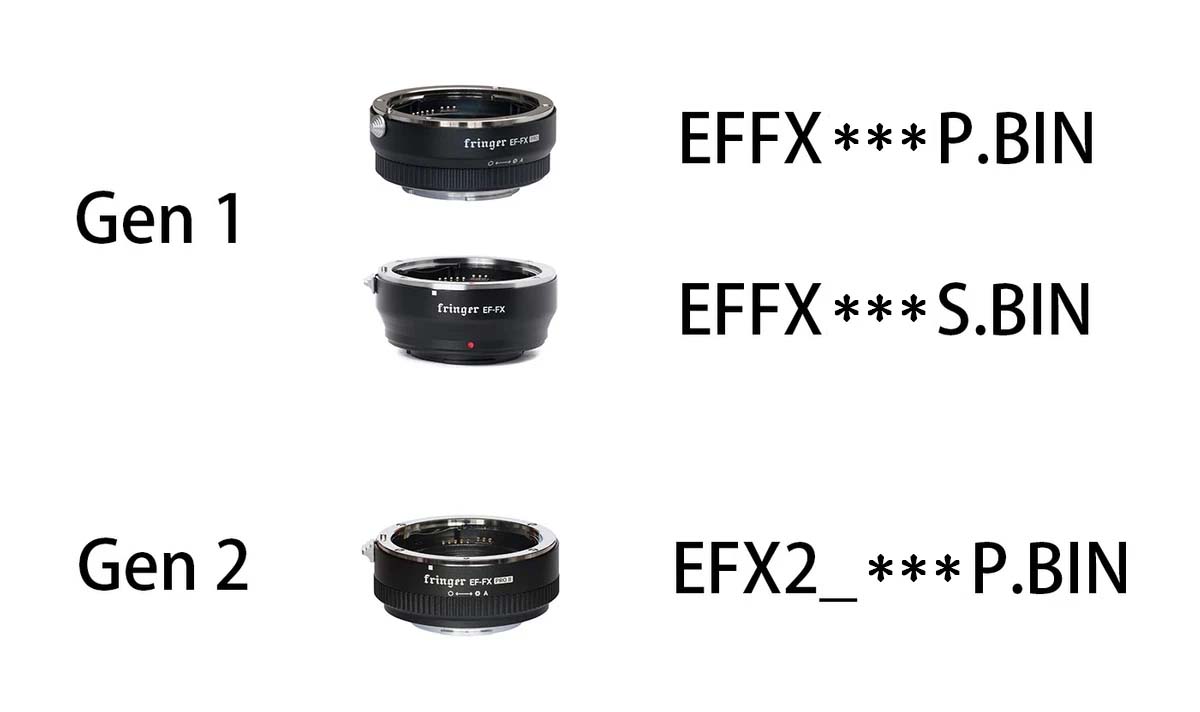
Be noted, make sure you download the correct file for the corresponding product. For Gen1, i.e. EF-FX Pro and EF-FX, you need firmware file named EFFX****.BIN. For Gen2, i.e. EF-FX Pro II, you need firmware file named EFX2_****.BIN. Using the wrong file will not damage your adapter. But it will not install.

Please visit our official website to download the new firmware, release notes and user’s manual.

To upgrade your adapter, connect it to a computer through a USB Micro B cable. Copy the corresponding firmware (.BIN file) to the emerged drive named “FRINGER”. Wait for 20 seconds. The adapter will upgrade itself.

Posted in 3rd Party Lens, Accessories| Tagged , , , , | Leave a comment