Viltrox 85mm f/1.8 V2/V1 Firmware Updates Released


Viltrox released firmware updates for the Viltrox 85mm f/1.8 V2 and V1 today. It’s good to see they are providing lots of updates for these budget lenses that many were happy with out of the box.

  1. Fixed the problem of inaccurate position at infinity
  2. Fixed the twitching problem when video focusing on the A5 body
  3. Fixed the issue that the camera would return to crash when viewing photos
  4. Optimized the focus speed
  5. Enhance stability

AF 85/1.8 II XF V1.0.8 Download Here
AF 85/1.8 I XF V1.1.2 Download Here

VILTROX 85mm f/1.8: B&H Photo / Amazon
VILTROX 85mm f/1.8II: B&H Photo / Amazon

VILTROX 23mm f/1.4: B&H Photo / Amazon
VILTROX 33mm f/1.4: B&H Photo / Amazon
VILTROX 56mm f/1.4: B&H Photo / Amazon

Please don’t forget to follow us on Facebook, Twitter, Instagram, YouTube

Plus our owners’ groups
Fujifilm GFX Owners Group
Fujifilm X-H Owners Group
Fujifilm X-T Owners Group
Fujifilm X-S Owners Group
Fujifilm X-Pro Owners Group
Fujifilm X-E Owners Group
Fujifilm X-A Owners Group
Fujifilm X100 Owners Group

Posted in 3rd Party Lens, Firmware| Tagged , , , , , , , , , , , , , , , , , , , , , , , , , , , , , , , , , , , , , , , , , , , | Leave a comment

Fujifilm Color, Image Quality, Color Science, Simulations, and More Interview


DC.Watch published part one of a very lengthy interview with Kosuke Irie, the Technical Manager, Optical and Electronic Video Product Development Center, and Shinya Fujiwara, the Optical and Electronic Video Product Development Center. Below is a summary of the translated interview:

What is the core of image quality that Fujifilm thinks about?

  • Image quality is about four elements: Color, Sharpness, Noise, and Graduation that you can break down further
  • These elements must be in balance for good results
  • When making a new simulation Fujifilm thinks “Are each color and each gradation pointing in the same direction?”
  • Eg during classic chromes development the dark red channel didn’t look as vivid as other channels to the human eye so it was pointing in a different direction of being designed to look vivid for documentaries
  • It’s difficult to set goals for developing looks especially since the cameras differ so much with new sensors and processors or even different IR/UV cut filter differences.
  • For example, it is impossible to make the X-T2 and X-T3 produce exactly the same film simulation results so all they can do is make users comfortable with the look
  • Fujifilm tried to design from the hardware up to provide a consistent comfortable look
  • Tonality is becoming more consistent due to market demands, but some simulations like Provia have changed how they handle shadow areas such as 16 or less between 0 and 255 to make them less likely to collapse

Origin of film simulation

  • The FinePix S100FS came out in 2008 and was the first camera with film simulations under real names, but even back to the FinePix S3 Pro in 2004 Fujifilm had standard and F Chrome Mode for film simulations, which was the origin of film simulation
  • Fujifilm developed simulations because they were criticized for their images having a digital feel and customers didn’t expect that from a film company
  • The silver halide film people helped develop a comfortable reproduction with little digital feeling in the FinePix F810 which was released Aug 2004 which had the first digital Provia look
  • The PROVIA look has been used since 2004 for Fujifilm’s standard film look and how it was designed has remained Fujifilm’s simulation theory largely without major changes up until now
  • They couldn’t use the PROVIA name back then so F1b and F2 were used until 2008 in when they started calling them film simulations

Is there a difference in image creation by sensor format?

  • X-Trans and Bayer have a different spatial frequency and are tuned differently, but ideals like sharpness are the same
  • The 102MP of the GFX100 allows for a state closer to the data since things like noise are buried in the pixels which allows for less noise reduction
  • “Comparing the images of the GFX series and the X series with the same print size, the GFX series has a smaller magnification. Therefore, the grain naturally looks fine. When printed at the same magnification, the GFX series and X series are granular in the same size. Of course, in this case, the print size will be significantly different.”
  • There are two ways to do digital grain, one is dithering, which uses random dots, but it gives off a digital order so Fujifilm makes it look natural by applying a process that looks grainy based on the sensors noise that gives a natural organic feeling like film
  • Fujifilm has two-grain looks that make it look comfortable, one is image processing to make noise look grainy and the other is the film simulation grain effect, which has different nuances
  • The grain effect from the simulation is randomly generated using a pseudo-random number generator circuit designed with great care mathematically and visually, which is what makes it different from the noise looking like grain effect
  • The thought is that humans find images that are too uniform to be artificial and unnatural so adding a little noise can have a positive effect since the human eye forms perceptions from the noise

About film simulation

  • Irie would like to find a better word than film simulation for Fujifilm’s film profiles because they aren’t necessarily trying to replicate film as much as creating good images so to him the label isn’t necessarily accurate
  • Film simulation is not a copy of film, but to achieve an image quality goal that has existed since the era of film of overall image quality
  • For example, ASTIA is aimed at achieving the same goals as silver halide film ASTIA, but digitally there are no restrictions on silver-halide and there are other disadvantages which have lead to simulations like digital ASTIA realizing what silver salt could not do
  • Irie doesn’t like to call ASTIA software, but that’s the terminology used internally, but its design intent is to reproduce soft skin with the intent of reproducing bright skin tones with smooth skin tones, but silver halide film ASTIA sometimes looks softer overall.
  • The “software” branch of ASTIA should just be considered ASTIA without calling it soft because it is designed to be closer to the ideals ASTIA film was based on and starting with the X-S10 Fujifilm is trying to better explain its simulations
  • We can do anything digitally, but Irie and others think film might have an advantage in terms of color continuity
  • Film is superior for capturing color information, but digital is better for gray linearity since it can be expressed as a complete grayscale
  • It’s very easy to do White, Black, and Grey with digital with great levels of accuracy because of the way the senor captures light
  • With silver halide film the shadows start to turn blue while highlights turn yellow
  • Film can obtain ambiguity and express color continuity with good tone connection that provides a beautiful reproduction that is difficult with digital
  • For example, there is nothing quite light positive film shot underwater with its very deep beautiful blue
  • We still have a lot to learn from film
  • Color Chrome is based on Fujifilm’s efforts to reproduce the deep color expression of films like positive film and it works by suppressing the development of some colors to create deep color reproduction

Approaching color reproduction of film simulation

  • Film simulations try to ensure a degree of accuracy and colorimetric that is tuned for comfort and natural reproduction
  • Faithful color reproduction is necessary for skin tones or the color of a car
  • Faithful colors must be perceived as the same color when compared to the actual scene so this is where memory color comes into play because you need color reproduction to fall between numeric accuracy and memory color for it to be accepted, which makes the image feel like “the same color” when they are viewed alone
  • PRO Neg. is the closest to colorimetry in film simulations
  • PRO Neg. Hi and Pro Neg. Std are mainly different in the tone curve with high having tight shadows and highlight, but the colors have the same design
  • “The design intention of PRO Neg.Hi and PRO Neg.Std is to consider the difference in studio lighting.”
  • PROVIA, Velvia, and ASTIA have a magenta tendency that helps bring out blue skies, which is more effective than colorimetry
  • Classic Chrome skin tones are created by part of a cool image that is shifting to warm
  • ETERNA is based on cinema ETERNA film which can make the sky look a little greenish-blue until it is projected on the big screen
  • A little Magenta should be added to ETERNA when using it for photography to make it look good and impressive, but in video you need the opposite
  • “The difference between movies and photographs is that not only the pictures move, but there are also “sounds” such as dialogue and music.”
  • So if an image is too impressive it can throw off the balance between the film, dialog, music, etc…
  • In cinema, the sky is deemphasized to with greenish-blue to make it less of a distraction
  • Classic Chrome also deemphasized the sky and can be used as a film simulation for cinema, but it is more expressive than cyan
  • Classic Negative is a special film simulation, and it is designed so that the appearance of colors changes depending on the brightness, so dark tones get cyan boosted and bright tones get magenta boosted like film
  • Once again digital allows Fujifilm to realize their ideas by allowing for this kind of adjustment, which film couldn’t achieve
  • Classic Negative might be a little too bold
  • Classic Negative gives you the feeling you get when you look at a color negative after more than 10 years
  • It’s not hard to do these kinds of auto adjustments, but it is hard to do without failure
  • “For example, even if you take a picture of a person’s face in one scene, there are many tones from highlight to shadow, so if you just turn the color according to the brightness, the skin tone is neutral in the halftone, but the shadow is green. The highlight becomes magenta, something like that happens in one face and it becomes a collapsed reproduction. It was really difficult to arrange such “directions for each color” and express film-like nuances within a range that does not break down.”
  • Irie was worried up until the end and he thinks that the color reproduction of classic negatives has a slightly ridiculous side
  • The deciding factor about releasing Classic Negative was that it was coming on the X-Pro3 which can be a little sharp
  • The non-missing feeling of classic negative expression comes from the balance of color and tone curve

Believe it or not, there is a part 2 coming for this very lengthy interview and I will cover it here too. If you want to read the whole interview it can be found here at DC.Watch.

Please don’t forget to follow us on Facebook, Twitter, Instagram, YouTube

Plus our owners’ groups
Fujifilm GFX Owners Group
Fujifilm X-H Owners Group
Fujifilm X-T Owners Group
Fujifilm X-S Owners Group
Fujifilm X-Pro Owners Group
Fujifilm X-E Owners Group
Fujifilm X-A Owners Group
Fujifilm X100 Owners Group

Posted in Interview| Leave a comment

Deal Zone: Lexar 256GB 1667x UHS-II SDXC Cards 50% Off Today Only


B&H Photo has the Lexar 256GB 1667x UHS-II discounted by 50% today only and you can get your own here.

Posted in Deals| Leave a comment

Fujifilm Hydro Ag + Inactivates 99% or More of SARS-CoV-2 Virus


Confirmed the continuous inactivating effect of the new coronavirus (SARS-CoV-2), a hand gel containing bactericidal ingredients utilizing Fujifilm’s original antibacterial technology “Hydro Ag + ”
FUJIFILM Corporation (President: Kenji Sukeno) has evaluated the hand gel containing bactericidal ingredients using our unique antibacterial technology “Hydro Ag + ” to confirm the effect on the new coronavirus (SARS-CoV-2). In the test, we obtained the result that 99% or more of the viruses were inactivated * 1 . This evaluation was conducted as part of joint research with Obihiro University of Agriculture and Veterinary Medicine.

About the hand gel used in this test
A hand gel containing a bactericidal ingredient with high moisturizing properties due to a water-soluble polymer. This product is mainly provided for medical institutions and nursing care sites.

[Outline and results of evaluation test]
(1) Evaluation after 20 seconds and 60 seconds of virus mixing
SARS-CoV-2 solution is mixed with this hand gel and pure water, respectively * 2 . After reacting at room temperature for 20 seconds and 60 seconds, the virus titers * 3 of the SARS-CoV-2 mixture of hand gel and pure water were compared to evaluate virus inactivation

<Evaluation result>
Hand gel showed more than 90% virus inactivation after 20 and 60 seconds of virus mixing. (table 1)
(Table 1) SARS-CoV-2 inactivation evaluation results for hand gel 20 seconds and 60 seconds after virus mixing * 4

Reaction time20 seconds60 seconds
Virus inactivation rate (%)90.00%99.32% or more

(2) Mix the virus 12 hours after application, and evaluate after 3 hours.
* 5 A test film coated with this hand gel and a test film coated with a prescription solution obtained by removing bactericidal components and silver-based antibacterial agents from the hand gel are allowed to stand at room temperature for 12 hours. After that, SARS-CoV-2 solution was dropped on each test film, and an unprocessed film was put on it to bring it into close contact, and the reaction was carried out at room temperature for 3 hours * 6 . After that, the SARS-CoV-2 solution was collected and the virus titer was calculated. The virus titers of the SARS-CoV-2 solution dropped on the hand gel and the SARS-CoV-2 solution dropped on the prescription solution obtained by removing the bactericidal component and the silver antibacterial agent from the hand gel were compared, and the hand gel was applied. We evaluated the virus inactivation of the test film.

<Evaluation result>
The test film 12 hours after application of the hand gel showed 98% or more virus inactivation. (Table 2)
(Table 2) SARS-CoV-2 inactivation evaluation results for test film 12 hours after hand gel application * 4

Elapsed time from hand gel application12 hours
Virus inactivation rate (%)98.22% or more

From this result, it can be expected that by using hand gel, 99% or more of the virus will be inactivated after 1 minute, and the virus on the hand will continue to be inactivated after that.

FUJIFILM will continue to contribute to the maintenance and improvement of people’s quality of life through advanced and unique technologies.

* 1 The virus inactivation rate depends on the application conditions. The application conditions are described in the outline of the evaluation test.
* 2 Mix 60 μl of SARS-CoV-2 solution (virus titer: 7.25 log 10 TCID 50 / ml) with 0.11 g of hand gel and pure water .
* 3 Viral titer (virus infectivity) is the amount of infectious virus contained in a sample. Rate of decrease in virus titer when compared with the target group = virus inactivation rate.
* 4 Based on the results of the “Verification experiment of inactivating activity of Fujifilm products against the new coronavirus (SARS-CoV-2)” conducted at Obihiro University of Agriculture and Veterinary Medicine on October 21, 2020. It is a result under the limited conditions in the laboratory and does not show the effect in the actual use site.
* 5 The coating amount is 0.5 g (equivalent to 1 push of hand gel) on a 100 cm 2 test film.
* 6 The virus titer of SARS-CoV-2 solution reacted with the test film is 6.25 log 10 TCID 50 / ml.

 Other Avigan/COVID-19/Hydro Ag +/Fujifilm Biomedical Coverage ( 1, 2, 3, 4, 5, 6, 7, 8, 9,10. 11, 12, 13, 14, 15, 16, 17, 18, 19, 20, 21, 22, 23, 24, 25, 26, 27, 28, 29, 30, 31, 32)

Please don’t forget to follow us on Facebook, Twitter, Instagram, YouTube

Plus our owners’ groups
Fujifilm GFX Owners Group
Fujifilm X-H Owners Group
Fujifilm X-T Owners Group
Fujifilm X-S Owners Group
Fujifilm X-Pro Owners Group
Fujifilm X-E Owners Group
Fujifilm X-A Owners Group
Fujifilm X100 Owners Group

Posted in Press releases| Tagged , , , , , , | Leave a comment

Savings Sunday Now With Holiday Savings


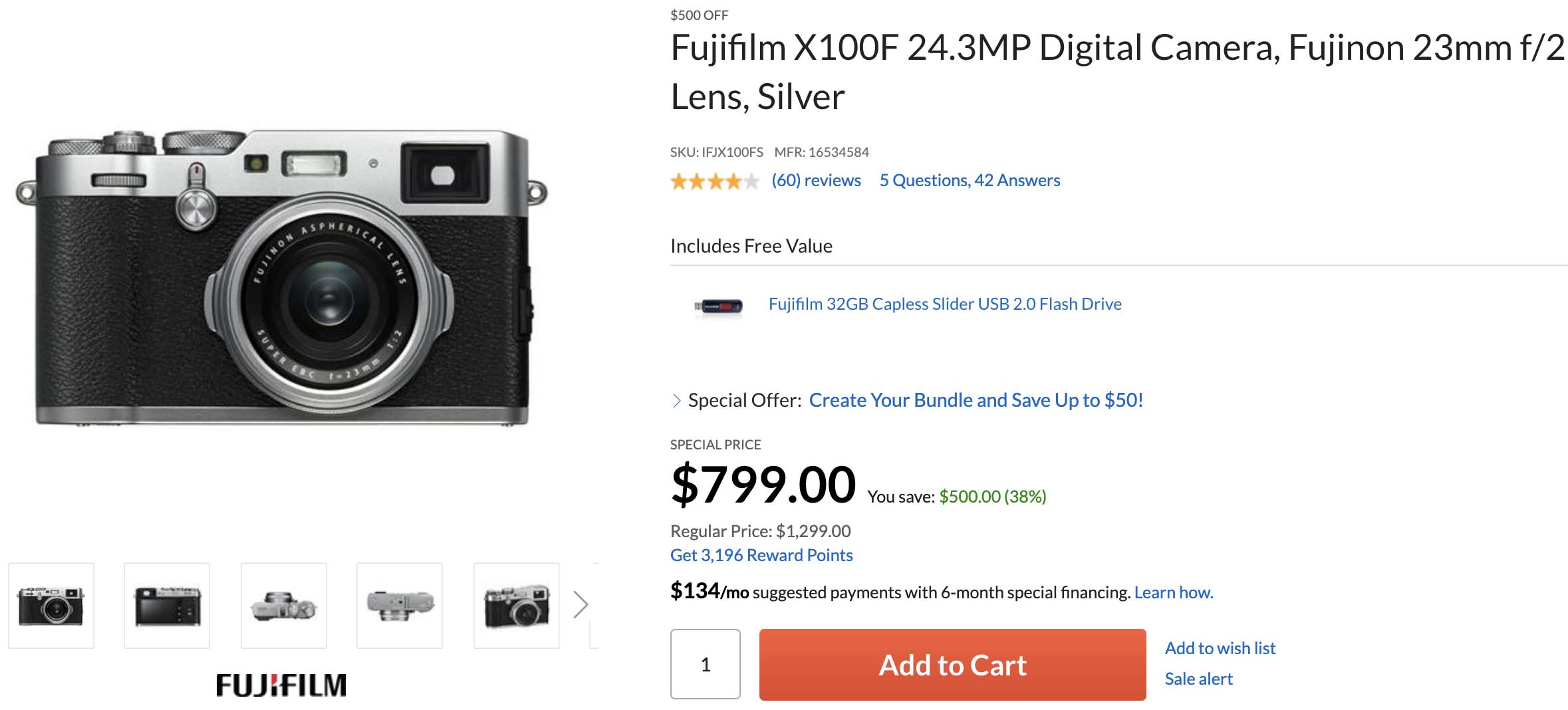
You can still pick up a Fujifilm X100F for $799 new from Adorama, which is the price that ok condition previous generation X100’s tend to sell for. Some even prefer the X100F over the new X100V which has a redesigned lens. If you have never owned an X100 then you really should pick one up because it is an excellent camera, which lead to the creation of the Fujifilm X Mount cameras.

Today Only Deals
Oben AC-1441 4-Section Aluminum Tripod with BA-111 Ball Head Save 43%
ProGrade Digital 64GB UHS-II SDXC Memory Card Save 29%
ProGrade Digital 256GB UHS-II SDXC Memory Card Save 30%
Samsung 2TB T7 Touch Portable SSD Save $140

Retailer General Savings
B&H Photo / Amazon / MomentShop / Adorama

iPad Deals
Apple iPad and iPad Pro All Configurations Save Up To $500

Save on Accessories
Atmos multiple configurations save up to $500

Anker Battery Banks Savings

WD 1TB My Passport Wireless SSD External Portable Drive Save $200 – See my review here

ONA Bags Savings

Robus Tripods $100-220 off

Lights
Luxli Lights $200-520 off

Godox Save Up to $230

Save on SD Cards
Lexar 128GB Professional 1667x UHS-II

Lexar 128GB Professional 2000x UHS-II

Sony 128GB SF-G Tough Series UHS-II

GFX
Fujifilm GFX50R (Save $1000): B&H Photo / Amazon / Adorama

X-Series
Fujifilm X-T4  (Save $200 w grip): B&H Photo / Adorama
Fujifilm X-T4 + Atomos V (Save $200): B&H Photo / Adorama
Fujifilm X-T3 + Atomos V (Save $500): B&H Photo
Fujifilm X-T3 (Save $500): B&H Photo / Amazon / Adorama
Fujifilm X-T30 (Save $100): B&H Photo / Amazon / Adorama
Fujifilm X-E3 (Save $200): Adorama
Fujifilm X-T200 (Save $250-300): B&H Photo / Amazon / Adorama

Fujinon Zoom Lenses
XF 16-55mm F2.8 R LM WR (save $300): B&H Photo / Amazon / Adorama
XF 50-140mm F2.8 R LM WR (save $300): B&H Photo /Amazon / Adorama
XF 55-200mm f/3.5-4.8 R LM OIS (save $200):  B&H Photo / Amazon / Adorama
XF 100-400mm f/4.5-5.6 R LM OIS WR (save $500): B&H Photo / Amazon / Adorama

Fujinon Fixed Focal Length Lenses
XF 23mm F1.4 R (save $150): B&H Photo /Amazon / Adorama
XF 60mm F2.4 Macro (Includes $250 Gift Card): Adorama
XF 90mm F2 R LM WR (Includes peak design bag and strap): Adorama

X-Mount Lenses
Variety of Discounted X-Mount Lenses in one place: B&H Photo

Instax
Various Instax Camera Savings up to $50 off
Instax SP-3 Photo Printer Save $80

Fujifilm Rugged Cameras
Fujifilm FinePix XP140 (Save $80): B&H Photo / Amazon / Adorama

Other Deals
Pelican Cases Discounted
X-Mount Lens Deals
Memory Card Savings
Power Banks

Battery Banks For Fujifilm Cameras
Anker PowerCore Speed 20000 PD
PowerCore+26800 PD
other more affordable options


New Apple Mac Pro: B&H Photo
New Apple iPad Pro and More: B&H Photo / Adorama
New Apple iMac Pro: B&H Photo / Adorama
New Apple MBP: B&H Photo / Adorama
New Apple M1: B&H Photo / Amazon / Adorama
MacBook Pro (Savings still available): B&H Photo

Limited time iPad Pro Savings
iPad Pro Bundles: B&H Photo


Software Deals
Luminar 4 & Aurora HDR 2019 (Savings code FUJIADDICT)
ON1 Photo RAW 2021
Photolemur
Picktorial


Godox V1 (Save $30): B&H Photo / Amazon / Adorama

Godox AD200Pro (Save $80+): B&H Photo / Adorama / Amazon
Godox AD200 (Save $70): 
B&H Photo / Amazon
Godox AD400Pro Witstro (Save $100): B&H Photo / Amazon / Adorama
Godox AD600Pro Witstro (Save $150): B&H Photo / Amazon
Godox AD1200Pro (Save $140): B&H Photo / Amazon

Godox TT350F (Save 10%): B&H Photo / Amazon
Godox V350F (Save 10%):  B&H Photo / Amazon / Adorama
Godox V860IIF (Save $40): B&H Photo / Amazon
Godox TT685F (Save $21): B&H Photo / Amazon

Posted in Deals| Leave a comment

DPRTV: Best And Worst Of Camera Gear Drinking Special

DPRTV is back with their end-of-year best and worst of camera gear drinking special and if you watch them on youtube like and subscribe to their channel it’s the metric DPR is using to judge them. It’s one of the more entertaining year-end wrap-ups out there so sit back and enjoy it or read through the highlights below:

Best Lens

  1. Sony 12-24mm f/2.8 GM
  2. Sigma 85mm f/1.4 DG DN Art
  3. Nikkor Z70-200 f/2.8 VS S
  4. Honorable Mention Tamron 70-180mm f/2.8

Best Hybrid Camera

  1. Sony a7SIII
  2. Panasonic S5
  3. Fujifilm X-T4 – straight out of the camera the best image quality

Best Stills Camera

  1. Canon EOS R5
  2. Fujifilm X-S10 – they love using this camera its most of the X-T4 in an affordable package
  3. Nikon Z5
  4. Honorable Mention Leica Q2
  5. Honorable Mention Fujifilm X100V
  6. Honorable Mention Olympus EM1 MarkIII

Best Trend of 2020 all the Telephoto lenses coming out thanks to the mirrorless emphases on keeping things small

Worst Trend of 2020 overheating cameras

Worst Lens Fujinon XF50mm f/1

Worst Camera Panasonic G100

Follow Fujiaddict on Facebook, Twitter, Instagram, and YouTube

Plus our owners’ groups
Fujifilm GFX Owners Group
Fujifilm X-H Owners Group
Fujifilm X-T Owners Group
Fujifilm X-S Owners Group
Fujifilm X-Pro Owners Group
Fujifilm X-E Owners Group
Fujifilm X-A Owners Group
Fujifilm X100 Owners Group

Posted in Fujifilm X-S10, Fujifilm X-T4, Fujifilm X100V| Tagged , , , , , , , , , , , , , , , , , , , , , , , , , , , , , , , , , , , , , , , | Leave a comment