


 FUJIFILM GFX ETERNA 55:
B&H Photo / Amazon / Adorama
FUJIFILM GF 32-90mm T3.5 PZ OIS WR:
B&H Photo / Amazon / Adorama
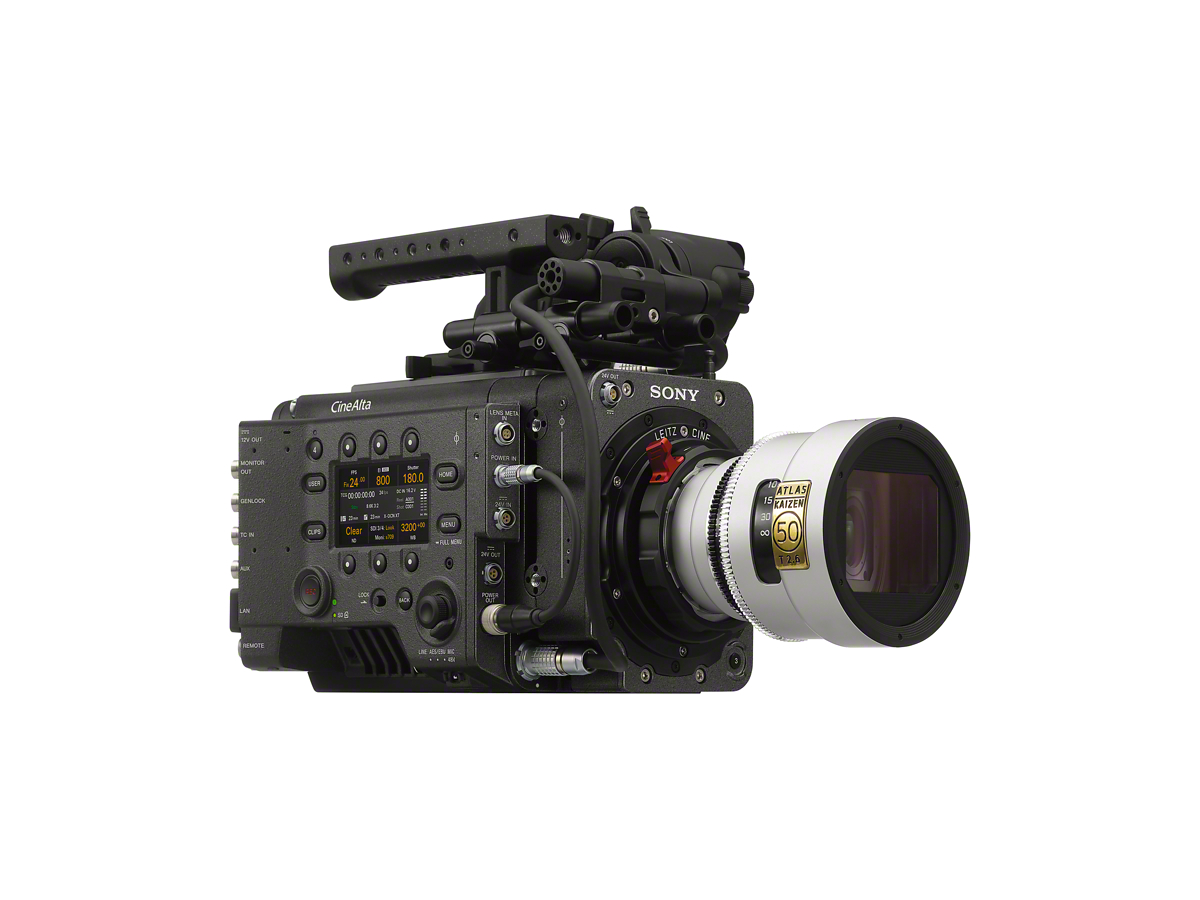
Sony RIALTO 65:
B&H Photo
On paper, both systems reject the traditional 35mm full-frame standard in favor of massive silicon real estate, shallow depth-of-field, and gentle three-dimensional focus roll-off. In practice, however, they represent two diametrically opposed engineering philosophies and financial realities. The FUJIFILM GFX ETERNA 55 is a self-contained, 2.0 kg medium format cinema camera retailing for $16,499.95. The Sony RIALTO 65 is an $80,000 modular sensor block and tether system that requires an existing ~$60,000 Sony VENICE 2 body just to power on and record.
Below is our exhaustive technical breakdown comparing sensor geometry, optical filtration, exposure latitude, codecs, lens ecosystems, and real-world cost of ownership between the Sony RIALTO 65 and the FUJIFILM GFX ETERNA 55.
1. Sensor Geometry, Aspect Ratios, and Multi-Format Cropping
To understand the visual difference between these two cameras, you have to look at physical sensor dimensions rather than just resolution numbers. A standard 35mm full-frame cinema sensor measures roughly 36 x 24 mm with a 43.3 mm image circle diagonal. Both Fujifilm and Sony push well past that boundary, but with different aspect ratio priorities.
FUJIFILM GFX ETERNA 55: The 55mm Tall-Sensor Specialist
The GFX ETERNA 55 is built around the 102MP GFX CMOS II HS sensor coupled with the X-Processor 5 engine. Measuring 43.8 x 32.9 mm with a 54.8 mm diagonal, it offers roughly 1.7x the surface area of a full-frame sensor. Crucially, Fujifilm incorporates a custom four-point separation Optical Low-Pass Filter (OLPF) engineered specifically for the 44 x 33 mm format to eliminate moiré and false color in high-contrast architectural and wardrobe textures.
Because its native aspect ratio is 4:3 (1.33:1), the GFX ETERNA 55 boasts a remarkably tall 32.9 mm vertical height—coming within less than 3 mm of the RIALTO 65’s vertical height. It also supports versatile multi-format sensor modes designed to match major cinema glass standards:
- GF Open Gate 4:3 (43.8 x 32.9 mm): Up to 4K (3840 x 2880) at 48p, ideal for 2x and 1.5x anamorphic desqueezing or multi-aspect commercial delivery.
- GF DCI 8K 17:9 (43.6 x 23.0 mm) & UHD 16:9: Up to 8192 x 4320 at 30p.
- Premista Mode (38.8 x 25.5 mm / 46.3 mm diagonal): Engineered specifically to match the image circle of Fujinon Premista large-format cinema zooms in 5.8K and 4K.
- 35mm Full-Frame (35.7 x 23.8 mm) & Super 35 (25.1 x 14.1 mm): Enables full compatibility with legacy PL-mount spherical and anamorphic lenses up to 60p.
Sony RIALTO 65 (CBK-6510XS): True 5-Perf 65mm Width
The Sony RIALTO 65 steps up to a true 65mm-class CMOS sensor measuring 53.75 x 35.83 mm with a 64.60 mm diagonal. That gives the RIALTO 65 roughly 2.2x the surface area of full-frame and approximately 33.5% more surface area than the GFX ETERNA 55. Its native aspect ratio is 3:2 (1.5:1) at a resolution of 9.6K (9564 x 6376), yielding roughly 61 megapixels of active photosites.
- 9.6K 3:2 Open Gate (9564 x 6376): Up to 30 fps using the full 53.75 x 35.83 mm area.
- 9.6K 16:9 (9564 x 5380) & 1.85:1 (9564 x 5170): Up to 30 fps.
- 9.6K 2.20:1 (9564 x 4348): Up to 50 fps, matching the classic 5-perf 65mm / 70mm theatrical projection standard made famous by Todd-AO and IMAX-adjacent large-format workflows.
- 9.6K 2.39:1 Widescreen (9564 x 4002): Up to 48/50 fps.
- Windowed S35 & Full-Frame Modes: Supports cropped 8K, 6.4K, 5.8K, and 4K modes for higher frame rates when pairing with standard 35mm PL/LPL glass.
The Takeaway: While the RIALTO 65 is nearly 10 mm wider horizontally (53.75 mm vs. 43.8 mm), the GFX ETERNA 55 packs a higher raw photosite count (102MP vs. ~61MP) and comes surprisingly close in vertical sensor height (32.9 mm vs. 35.83 mm).
2. Master Specification Comparison
| Specification | FUJIFILM GFX ETERNA 55 | Sony RIALTO 65 (CBK-6510XS) |
|---|---|---|
| System Architecture | Standalone All-in-One Cinema Camera | Modular Sensor Block / Tether for VENICE 2 |
| Active Sensor Size | 43.8 x 32.9 mm (54.8 mm diagonal) | 53.75 x 35.83 mm (64.60 mm diagonal) |
| Total Sensor Area | 1,441 mm² (~1.7x Full-Frame) | 1,925.8 mm² (~2.2x Full-Frame) |
| Photosite Count | 102 Megapixels (GFX CMOS II HS) | ~61 Megapixels Effective (9564 x 6376) |
| Native Open Gate Ratio | 4:3 (1.33:1) | 3:2 (1.50:1) |
| Max Video Resolution | 8K DCI (8192 x 4320) / 4K Open Gate | 9.6K Open Gate (9564 x 6376) |
| Max Frame Rates | 8K up to 30p | 4K 4:3 up to 48p | S35 60p | 9.6K 3:2 up to 30p | 9.6K 2.20:1 up to 50p |
| Optical Low-Pass Filter | Yes (4-Point Separation OLPF) | Integrated Cinema Optical Filtering |
| Dual Base ISO | ISO 800 / ISO 3200 | ISO 2500 / ISO 10000 |
| Dynamic Range | 14+ Stops (F-Log2 / F-Log2 C) | 15+ Stops (Measured at Base ISO 2500) |
| Internal Recording | 10-bit 4:2:2 ProRes 422 HQ/422/LT, HEVC | 16-bit X-OCN (XT/ST/LT) + 4K ProRes via VENICE 2 |
| RAW Output | 12-bit 8K/30p External (ProRes RAW / BRAW) | 16-bit Internal X-OCN onto Sony AXS Media |
| Recording Media | 1x CFexpress Type B + 1x SD UHS-II + SSD | Dual Sony AXS Memory Slots + 1x SD Slot |
| ND Filter Mechanism | Internal Electronic Variable ND (0.6 to 2.1) | 11 Physical Drop-in Filters (0.3 to 3.0 + Clear) |
| Lens Mount System | Native G-Mount + Included PL Mount (/i Tech) | Interchangeable Third-Party Mount Interface |
| Autofocus System | Phase-Detect Hybrid AF + AI Subject Tracking | None (Manual / Cinema Wireless FIZ Only) |
| Weight | 2.0 kg (4.41 lbs) Standalone Body | 1.5 kg (3.3 lbs) Head + 4.3 kg VENICE 2 Body |
| Release Status | In Stock & Shipping (Launched Oct 2025) | Scheduled for First Half of 2027 |
| MSRP (USD) | $16,499.95 (Ready-to-Shoot Body) | $80,000 (Extension Only) / ~$140,000+ System |
3. Exposure Latitude, Dual Base ISO, and ND Filter Engineering
Large-format cinematography presents a well-known physical challenge: as sensor size increases, depth of field becomes razor-thin at equivalent fields of view. Cinematographers often need to stop down to T4, T5.6, or T8 just to keep an actor’s eyes and nose in focus simultaneously, or rely on subtle filtration in bright daylight.
Sony’s Extreme Sensitivity vs. Physical Drop-In NDs
Sony engineered the RIALTO 65 with an extraordinary Dual Base ISO of 2500 and 10000, paired with 15+ stops of dynamic range. Having a clean native ISO 10000 in a 65mm sensor is a massive advantage for night exteriors, volume wall virtual production, and stopping down slower vintage 65mm lenses indoors without bringing in 18K HMIs.
However, that high base ISO creates a trade-off in daylight. Because of the massive 64.6 mm sensor diagonal and shallow clearance behind interchangeable 65mm mounts, Sony could not fit its signature 8-step motorized servo ND turret from the VENICE 2 into the RIALTO 65. Instead, the RIALTO 65 uses a set of 11 physical slide-in optical ND filters (Clear plus 1 to 10 stops in 0.3 increments) with electronic metadata contacts so the camera recognizes which filter is inserted. While optically pristine, changing ND requires a 1st AC to physically pull and swap filter trays between setups—and a spare filter kit (CBK-6510ND) costs $8,000 by itself.
Fujifilm’s Large-Format Electronic Variable ND Breakthrough
The FUJIFILM GFX ETERNA 55 features a traditional cinema Dual Base ISO of 800 and 3200 with 14+ stops of dynamic range when shooting in F-Log2 or the wider-gamut F-Log2 C. While ISO 3200 cannot match Sony’s ISO 10000 in near-darkness, ISO 800 is far easier to manage in sunny exterior conditions.
More importantly, Fujifilm achieved a major optical engineering milestone by building an electronically controlled Variable ND (eVND) filter directly over the 44 x 33 mm sensor. Covering ND0.6 (2 stops) to ND2.1 (7 stops), operators can dial filtration seamlessly in ultra-fine 0.015-stop increments or standard discrete steps at the touch of a button. You can even execute automated exposure ramps during a continuous crane or Steadicam shot moving from a dark interior into bright midday sun—something physically impossible with the RIALTO 65’s drop-in trays.
4. Color Science, Codecs, and Post-Production Pipelines
16-Bit X-OCN vs. Internal ProRes & 12-Bit RAW
Because the RIALTO 65 offloads all processing and recording to the Sony VENICE 2 body, it inherits one of Hollywood’s most respected post-production pipelines: internal 16-bit X-OCN (Extended tonal range Original Camera Negative) in XT, ST, and LT compression flavors, recorded directly to dual AXS memory cards alongside 4K ProRes 4444/422 HQ proxies. For heavy VFX compositing, IMAX mastering, and high-end Dolby Vision HDR grading, 16-bit linear X-OCN at 9.6K provides unmatched highlight recovery and shadow bit-depth.
The FUJIFILM GFX ETERNA 55 targets high-efficiency turnaround without sacrificing grading flexibility. Internally, it records 10-bit 4:2:2 Apple ProRes 422 HQ, ProRes 422, ProRes 422 LT, and H.265/HEVC onto affordable CFexpress Type B cards, plus simultaneous proxies to SD UHS-II. When a production demands RAW latitude, the GFX ETERNA 55 outputs 12-bit 8K/30p or 4K Open Gate 48p RAW over HDMI to Atomos recorders (ProRes RAW) or Blackmagic Video Assist 12G recorders (Blackmagic RAW).
Motion Picture Heritage: S-Gamut3.Cine vs. Fujifilm ETERNA & F-Log2 C
Sony’s S-Log3 / S-Gamut3.Cine color pipeline is the backbone of modern streaming series and theatrical features, designed to intercut seamlessly with ARRI LogC. Yet Fujifilm brings 90 years of actual celluloid motion picture chemistry to the table. Beyond F-Log2 C—which expands the color gamut beyond standard F-Log2 to preserve saturated neon and LED stage primaries—the GFX ETERNA 55 ships with 20 built-in Film Simulations and support for 16 custom 3D LUTs, including Fujifilm’s official LUTs modeled directly after its legendary 35mm motion picture negative stocks (ETERNA 500T, ETERNA 400T, ETERNA 250D, and ETERNA 250T). Combined with direct Frame.io Camera to Cloud (C2C) hardware integration over built-in Wi-Fi or Gigabit Ethernet, dailies with baked-in ETERNA LUTs can reach an editor’s timeline seconds after calling cut.
5. Lens Mounts, Optics, and Focus Workflows
Buying or renting a large-format camera is only half the equation; finding glass that covers the image circle is where budgets often spiral out of control.
- Sony RIALTO 65 Lens Ecosystem: Covering a 64.60 mm image circle in Open Gate requires specialized 65mm optics—such as ARRI Rental Prime 65 / DNA, Panavision System 65, Hasselblad V/H cine-rehoused primes, Leitz Thalia, or Pentax 67 rehoused glass. Because there is no single universal 65mm cinema mount standard, the RIALTO 65 ships without a native lens mount, utilizing an interchangeable mount interface designed to accept third-party adapters (LPL, XPL, Panavision 65, etc.). All focus pulling is strictly manual or driven via wireless cinema FIZ (Focus/Iris/Zoom) motors.
- FUJIFILM GFX ETERNA 55 Lens Ecosystem: With a 54.8 mm image circle and a remarkably short 16 mm flange focal distance on its native G-mount, the GFX ETERNA 55 is one of the most adaptable cinema cameras ever built. It includes a rugged PL Mount Adapter G with Cooke /i Technology electronic contacts right in the box, allowing it to accept modern VistaVision / Full-Frame Plus cinema primes (ARRI Signature Primes, Zeiss Supreme Primes, Cooke S7/i, Fujinon Premista) with minimal or zero vignetting. Better still, removing the PL adapter lets you mount native Fujifilm GF glass—including the dedicated Fujinon GF 32-90mm T3.5 PZ OIS WR power zoom—unlocking deep-learning phase-detect Hybrid Autofocus and optical image stabilization for gimbal, jib, and documentary work.
6. Modularity, Ergonomics, and True Cost of Ownership
The Sony RIALTO 65 is engineered around two physical configurations:
- Studio Mode: The RIALTO 65 sensor assembly docks directly onto the front of a VENICE 2 chassis (replacing the standard 8K/6K sensor block via a dedicated docking adapter), forming a unified 65mm studio camera body.
- Extension Mode (Tethered): Using the included 4.5-meter umbilical cable—or the optional $9,000 12-meter cable (CBK-6510CB12)—the 1.5 kg (3.3 lb) RIALTO 65 head detaches from the VENICE 2 brain. This allows a 65mm sensor to be rigged inside tight car interiors, mounted on lightweight handheld gimbals, hung from helmet rigs, or flown on technocranes while an assistant carries or mounts the VENICE 2 recorder housing separately.
By contrast, the FUJIFILM GFX ETERNA 55 weighs just 2.0 kg (4.41 lbs) as an entire, self-contained camera. There is no umbilical cable to snag on doorframes and no separate 4.3 kg recorder brain required. It features dual 3-inch 700-nit side operator displays on both the left and right flanks of the body, an included 5-inch 2000-nit daylight-viewable touchscreen LCD, a native V-mount battery back, and an internal hot-swappable NP-W235 battery slot that keeps the camera running while you swap V-mount bricks on set.
Real-World System Price Comparison
| Component | FUJIFILM GFX ETERNA 55 Package | Sony RIALTO 65 + VENICE 2 Package |
|---|---|---|
| Base Camera / Brain | $16,499.95 (Complete Camera Body) | ~$60,000.00 (Sony VENICE 2 8K Body) |
| 65mm / Large Sensor Unit | Included | $80,000.00 (CBK-6510XS RIALTO 65) |
| PL Lens Mount Adapter | Included (PL Mount Adapter G w/ /i Tech) | ~$2,500 – $4,000 (Third-Party LPL/XPL Mount) |
| On-Board Monitor & Handle | Included (5″ 2000-nit LCD + Top Handle) | ~$6,500.00 (Sony DVF-EL200 OLED Viewfinder) |
| Recording Media (2x 1TB) | ~$700.00 (2x 1TB CFexpress Type B) | ~$9,200.00 (2x 1TB Sony AXS-A1TS66 + Reader) |
| Optional Long Cable / Backup NDs | N/A (Internal eVND & Self-Contained) | $17,000.00 ($9K 12m Cable + $8K ND Set) |
| Estimated Production-Ready Total | ~$17,200 USD | ~$158,200 – $175,200 USD |
7. The FujiAddict Verdict: Hollywood Rental Exclusivity vs. Accessible Medium Format Brilliance
Make no mistake: the Sony RIALTO 65 is an extraordinary achievement for the ultra-high-end narrative and IMAX commercial market. By turning thousands of existing Sony VENICE 2 bodies sitting on rental shelves at Keslow, Panavision, and Otto Nemenz into 9.6K 16-bit X-OCN 65mm cameras—complete with Dual Base ISO 2500/10000 and a 1.5 kg tetherable head—Sony has mounted its most serious challenge yet to the rental-only ARRI ALEXA 65 and the Blackmagic URSA Cine 17K 65. However, with an $80,000 price tag just for the sensor extension and a release window pushed out to the first half of 2027, it is strictly a tool for top-budget studio productions with full camera departments.
That reality makes what Fujifilm has accomplished with the FUJIFILM GFX ETERNA 55 look even more remarkable. You do not need to wait until 2027, you do not need a $160,000 equipment budget, and you do not need a tethered two-operator backpack rig to shoot true medium format cinema. For $16,499.95—just slightly more than the cost of Sony’s optional 12-meter cable and spare ND filter tray combined—the GFX ETERNA 55 delivers a 55mm-diagonal 102MP sensor, an internal electronic variable ND filter, internal ProRes 422 HQ, 8K 12-bit RAW output, hybrid phase-detect autofocus, and both G-mount and PL-mount versatility in a self-contained 2 kg body you can buy and shoot with today.
Bottom Line for Filmmakers: If you are prepping a $100M tentpole feature with a dedicated 1st and 2nd AC, an AXS RAW workflow, and a rental budget for 65mm prime lenses, the Sony RIALTO 65 will be a formidable weapon when it arrives in 2027. For independent directors of photography, commercial production companies, documentary filmmakers, and owner-operators who want the unmistakable spatial compression and organic depth of medium format right now, the FUJIFILM GFX ETERNA 55 remains in a league of its own.
