Fujifilm released its financial results on August 6th, but the Q&A from the financial results call was only just published, and there is an interesting forward-looking statement in the Q&A that you can read below:
Moderator [M]: Thank you. Next, Ms. Yamazaki from Morgan Stanley MUFG Securities.
Yamazaki [Q]: This is Yamazaki from Morgan Stanley MUFG Securities.
I have one question each on the Imaging and the CDMO business.
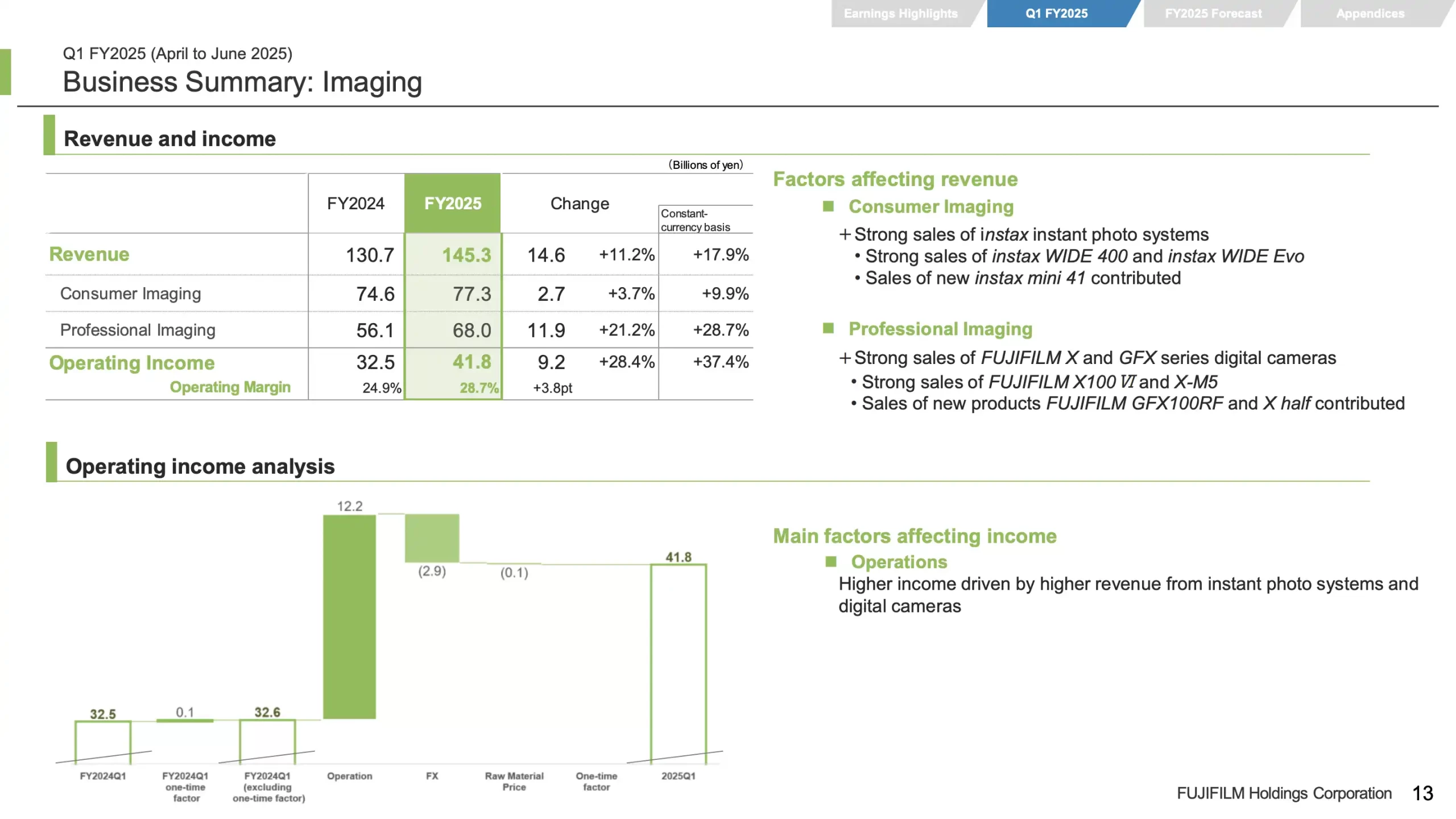
First, regarding Imaging, my understanding is that operations in Q1 were very strong. Looking ahead to Q2 and beyond, are there any risks you’re keeping an eye on that you could share with us?
Goto [A]: Goto here. Let me respond.
Yes, Q1 was indeed a very strong quarter for us. The reasons include solid performance from the instax line, WIDE 400, WIDE Evo, and also Link 3, which we launched in the previous fiscal year, all performed well. In April, we launched the mini 41, which has a classic design, and that product also generated solid numbers.
As for digital cameras, the X100VI, an X100 series, and the half-frame X half model are both doing very well, with a significant backlog of orders building up. Demand continues to be strong.
We still have several new products in the pipeline, and we expect the upward trend to continue.
Even if inflation in the U.S. leads to weaker demand or consumer hesitation, we believe there are still plenty of other markets globally where we can absorb that impact. We can shift focus to those areas, and if we do that well, we expect the strong performance to continue through the rest of the year.
Fujifilm was also asked about the impact of tariffs on Fujifilm’s business, and it sounds like Fujifilm has it under control.
Back on May 8, we could only present a very wide estimate for the impact of tariffs: USD140 million, plus or minus USD100 million. That was the best we could do at the time. But in the end, it came in much closer to the lower end of the range. The JPY6 billion figure we landed on equates to about USD40 million, so we were able to bring it down quite close to that lower end. And what’s more, we’ve incorporated that JPY6 billion tariff impact into our full-year forecast without changing our initial plan. In other words, we effectively raised the forecast.
Speaking personally, to be honest, the outlook from here is still very unclear. But if foreign exchange rates stay relatively stable, if geopolitical conflicts don’t worsen, and if inflation in the U.S. remains within a manageable range, then I believe it’s possible for us to exceed the current forecast of JPY331 billion in operating income.
One of the strategies we’re working on, in case inflation in the U.S. pushes prices too high and demand for our products starts to drop, is identifying alternative markets, where else we can drive sales, especially for our Imaging and Medical Systems businesses.
Right now, we’re actively targeting India, the Middle East, Central Asia, and Africa. These regions are becoming valuable entry points for us, helping us open up new markets and expand the overall pie. That’s how we’re thinking about offsetting any slowdown that might come from a U.S. economic downturn.
Follow Fujiaddict on Facebook, Twitter, Instagram, and YouTube
Plus our owners’ groups
Fujifilm GFX Owners Group
Fujifilm X-H Owners Group
Fujifilm X-T Owners Group
Fujifilm X-S Owners Group
Fujifilm X-Pro Owners Group
Fujifilm X-E Owners Group
Fujifilm X-A Owners Group
Fujifilm X100 Owners Group