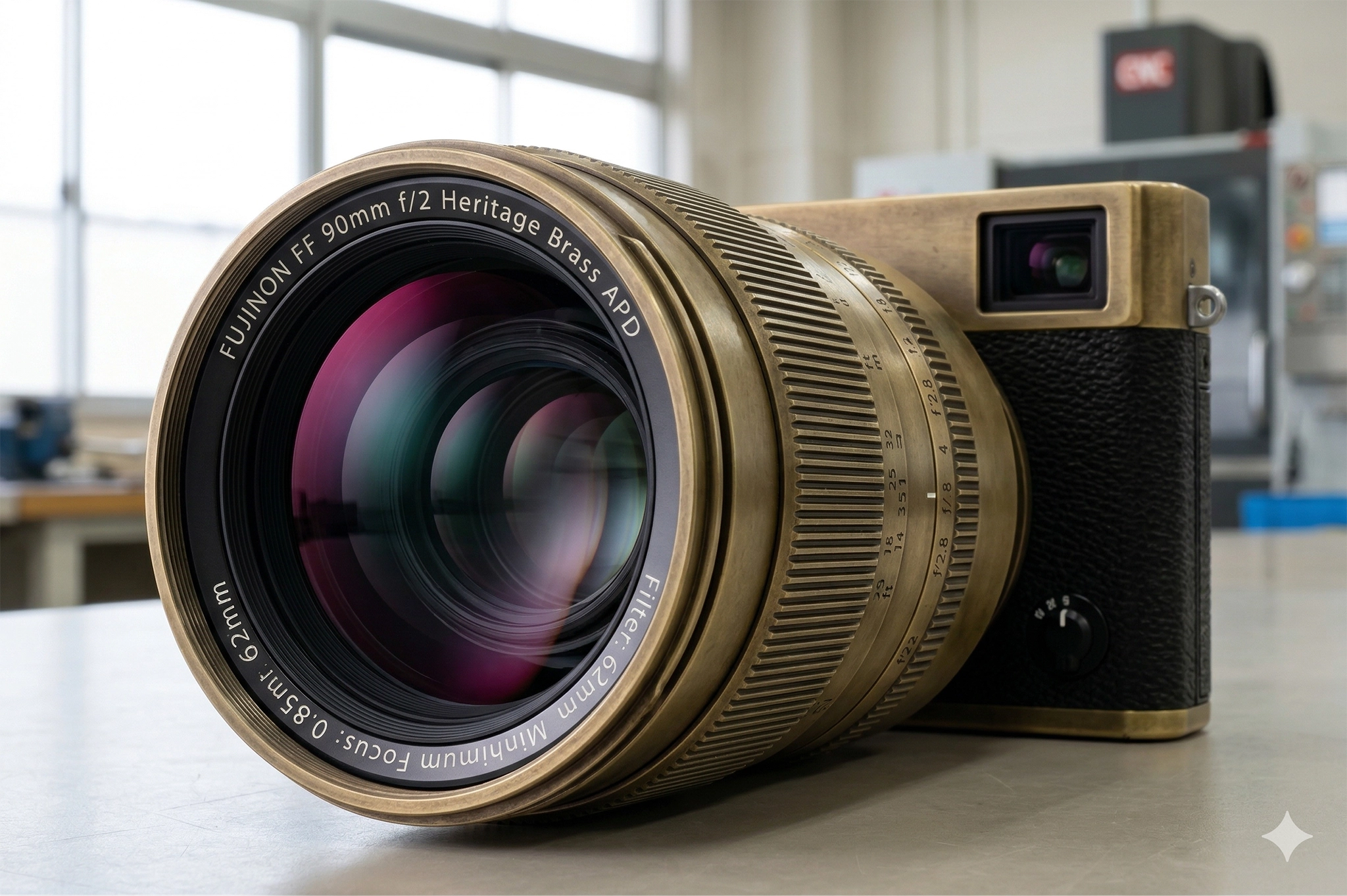
April 1, 2026 — Tokyo, Japan — In a move that has sent shockwaves through the photography world, FUJIFILM Corporation has officially announced the GFR-1, the company’s first-ever full-frame (36×24mm) digital camera — and it’s a rangefinder.
The announcement, made during a surprise follow-up to the company’s Focus on Glass event held earlier this year, confirms months of speculation that the mysterious brass lens elements teased during that presentation were destined for something far more ambitious than anyone imagined.
“For over a decade, Fujifilm has proven that sensor size is not the sole determinant of image quality,” said Fujifilm Imaging Division General Manager Toshihisa Iida during the virtual keynote. “But our engineers asked a different question: what if we brought our philosophy — our colour science, our film heritage, our commitment to the tactile joy of photography — to a full-frame canvas? The GFR-1 is that answer.”
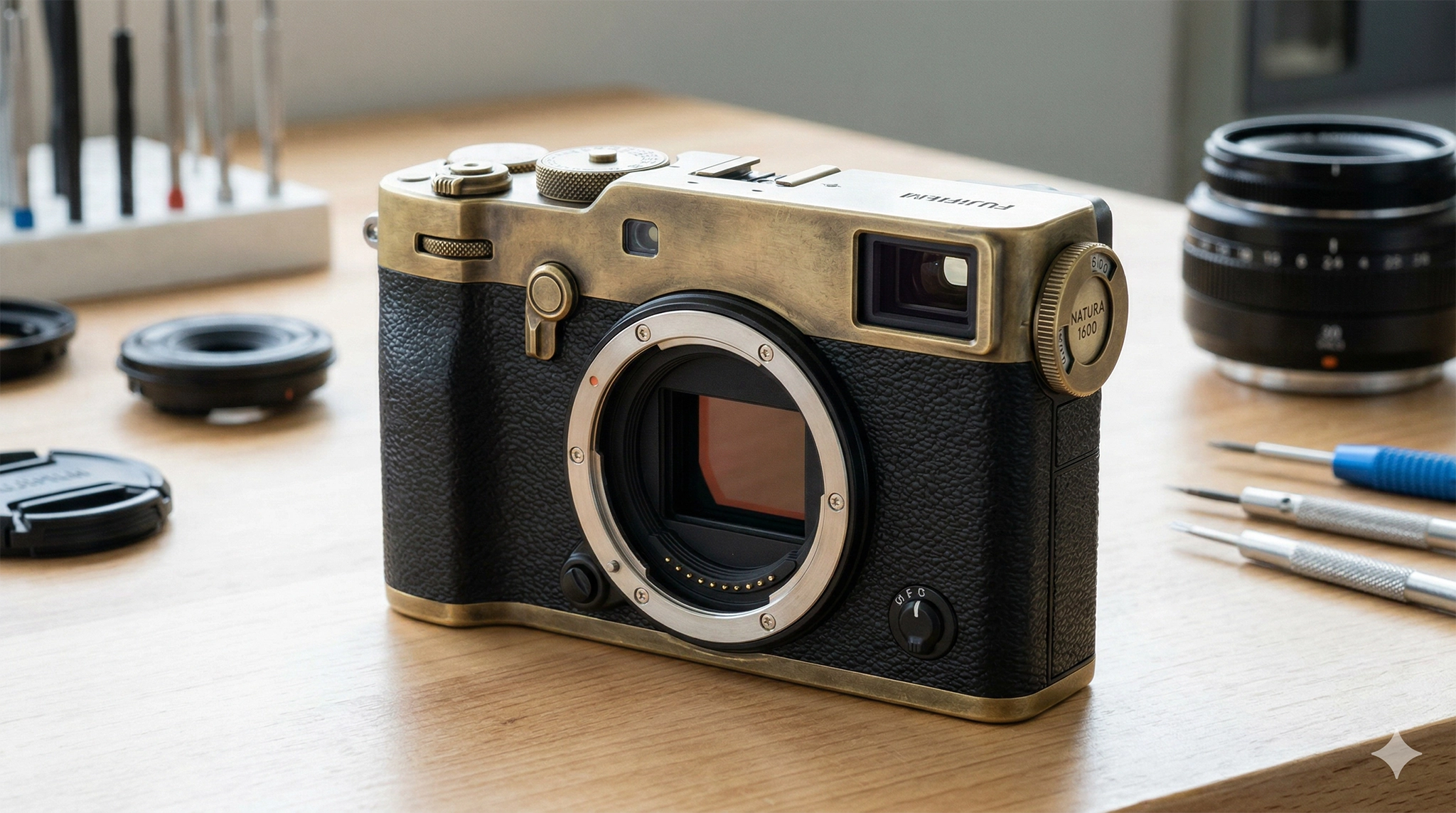
The GFR-1 is, unmistakably, a rangefinder. Its silhouette will feel immediately familiar to devotees of the Leica M system — but Fujifilm has layered in its own DNA at every level.
The body is constructed from a magnesium alloy chassis clad in a hand-finished brass top plate and base plate, paired with Fujifilm’s signature textured synthetic leather. At 138 × 80 × 39mm and 485g (body only), the GFR-1 is fractionally wider but noticeably thinner than a Leica M11, and approximately the same weight.
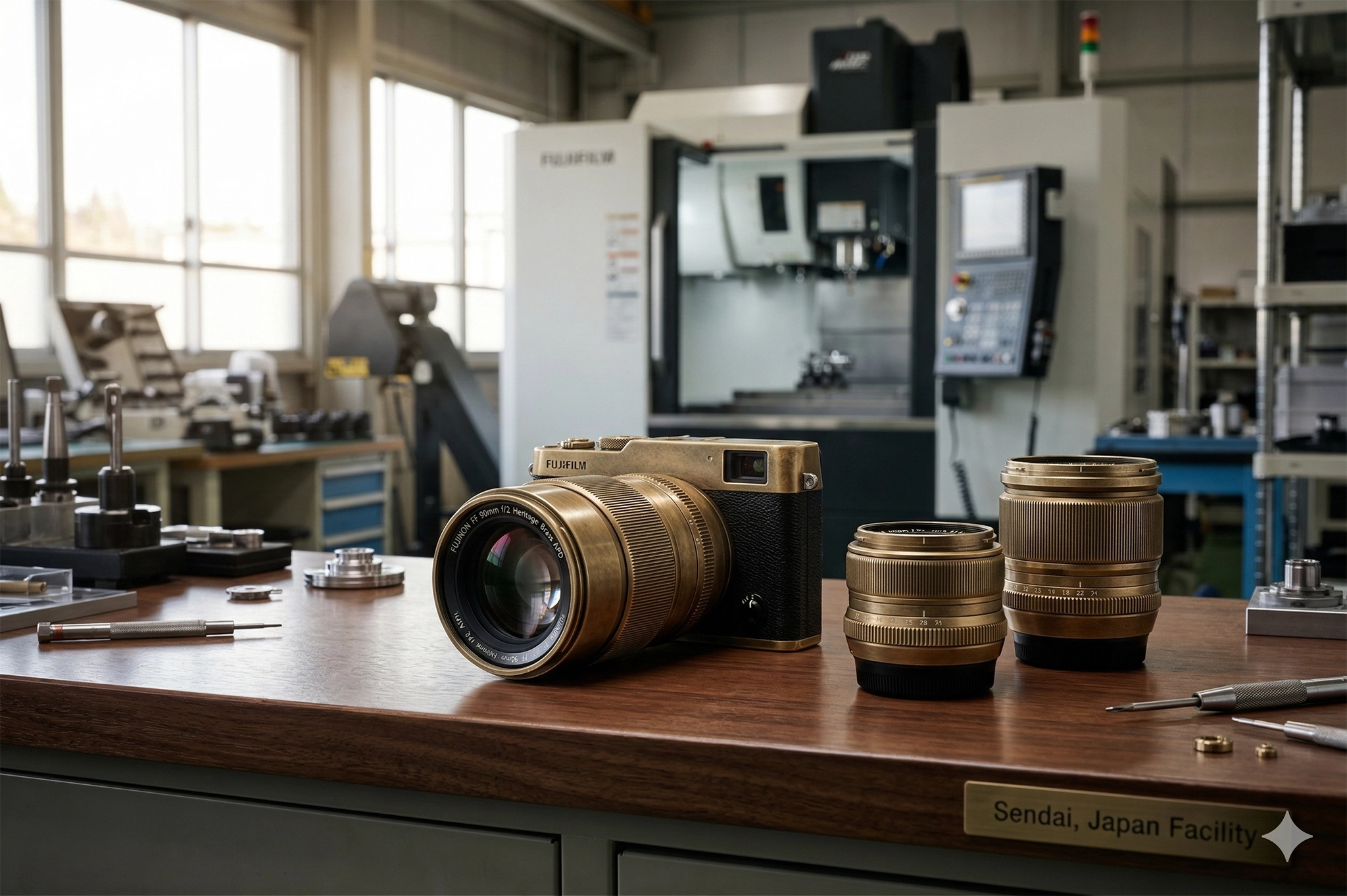
The brass components are not plated — they are solid brass, CNC-machined in Fujifilm’s optical manufacturing facility in Sendai, Japan. Over time, the top and base plates will develop a natural patina unique to each camera, a deliberate design choice that Fujifilm says reflects the company’s belief that “a camera should age alongside the photographer.”
At the heart of the GFR-1 is a newly developed 61-megapixel back-side-illuminated full-frame CMOS sensor (no AA filter), paired with Fujifilm’s latest X-Processor 6 imaging engine. The sensor features a novel colour filter array that Fujifilm calls “ChromaWeave,” which the company claims delivers colour reproduction more faithful to its original film stocks than any previous digital sensor — including those in the GFX medium format line.
Key specs include:
Fujifilm has developed what it calls the Hybrid Rangefinder Viewfinder (HRF), drawing directly on the technology pioneered in the X-Pro series. The HRF offers three modes:
The GFR-1 ships with 24 Film Simulations, including all existing simulations from the X and GFX series, plus four brand-new simulations exclusive to the GFR-1 at launch:
All Film Simulations can be applied in-camera to JPEG and HEIF output, or baked into the video pipeline for direct-to-edit footage. RAW files retain full processing latitude.
In a design touch that will delight X-series loyalists, the GFR-1 features a dedicated physical Film Simulation Dial on the rear right shoulder. The vertically oriented brass dial clicks through simulations with a satisfying detent action, with the currently selected simulation name visible through a small window — echoing the feel of selecting film stock for a mechanical camera.
The GFR-1 introduces an entirely new mount system: the Fujifilm FF Bayonet Mount, designed specifically for full-frame rangefinder optics. The mount has a flange distance of 27.8mm — identical to the Leica M mount — which Fujifilm says is “not a coincidence.”
The FF mount is natively compatible with Leica M-mount lenses. No adapter required. Every Leica M lens, past and present, will mount and function on the GFR-1, including full rangefinder coupling. Fujifilm will also offer an optional electronic adapter for the company’s own X-mount lenses, with AF support, though this introduces a 1.0x crop.
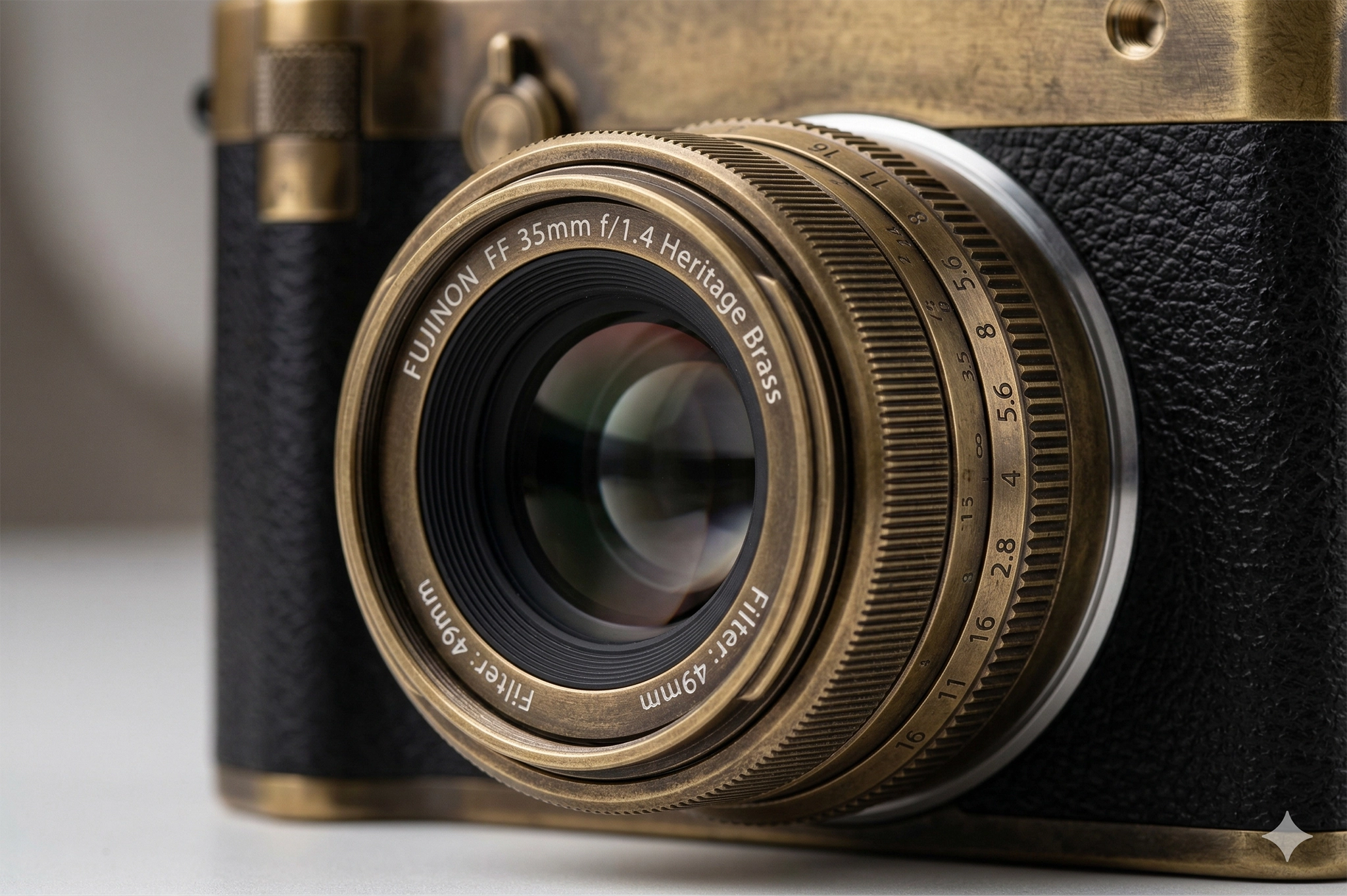
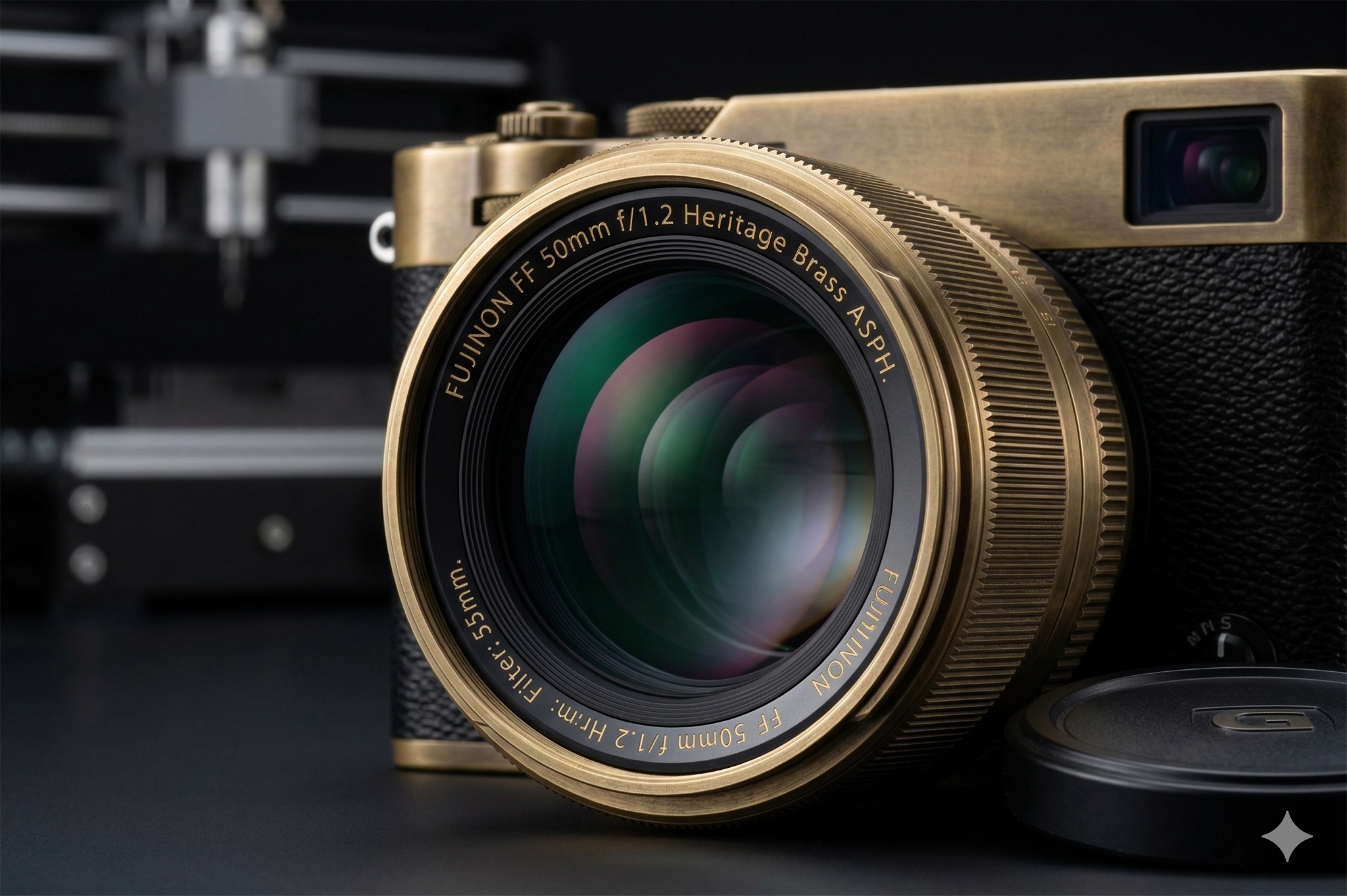
At launch, three all-new FUJINON lenses will be available, all featuring solid brass barrel construction, manual focus with a silky-smooth helicoid, and Fujifilm’s latest Super EBC multi-coating:
The street photographer’s lens. A classic 35mm in a compact brass package. 9 elements in 7 groups, including 2 aspherical elements. The optical formula draws from Fujifilm’s decades of experience with the XF 35mm f/1.4 — universally loved for its rendering — but recalculated for the full-frame image circle. Expect the same creamy bokeh character with modern sharpness.
The portrait and low-light standard. The flagship of the launch lineup. 11 elements in 8 groups, with 3 aspherical elements and 1 ED element. At f/1.2 the lens produces extraordinarily shallow depth of field with a smooth, undulating bokeh that Fujifilm describes as having a “dimensional quality” — subjects appear to separate from their backgrounds in a way that is uniquely three-dimensional, reminiscent of vintage fast fifties but with none of the optical compromises.
The bokeh master. A short telephoto with Fujifilm’s apodisation (APD) filter — the technology beloved in the XF 56mm f/1.2 APD — which produces an extraordinarily smooth bokeh transition from in-focus to out-of-focus areas. The APD filter reduces the effective transmission to T/2.4, but the rendering quality is, Fujifilm claims, “in a class of its own.”
A further four lenses are on the roadmap for 2026–2027: a 28mm f/2, 40mm f/2 (pancake), 75mm f/1.4, and a 135mm f/2.8 telephoto.
| Product | Price (USD) | Availability |
|---|---|---|
| GFR-1 Body (Heritage Brass) | $3,499 | July 2026 |
| GFR-1 Body (All Black) | $3,299 | September 2026 |
| FUJINON FF 35mm f/1.4 Brass | $1,299 | July 2026 |
| FUJINON FF 50mm f/1.2 Brass ASPH. | $1,899 | July 2026 |
| FUJINON FF 90mm f/2 Brass APD | $2,199 | August 2026 |
| X-Mount to FF Adapter (electronic) | $299 | July 2026 |
Pre-orders open April 15, 2026 at B&H Photo, Amazon, and authorised Fujifilm dealers worldwide.