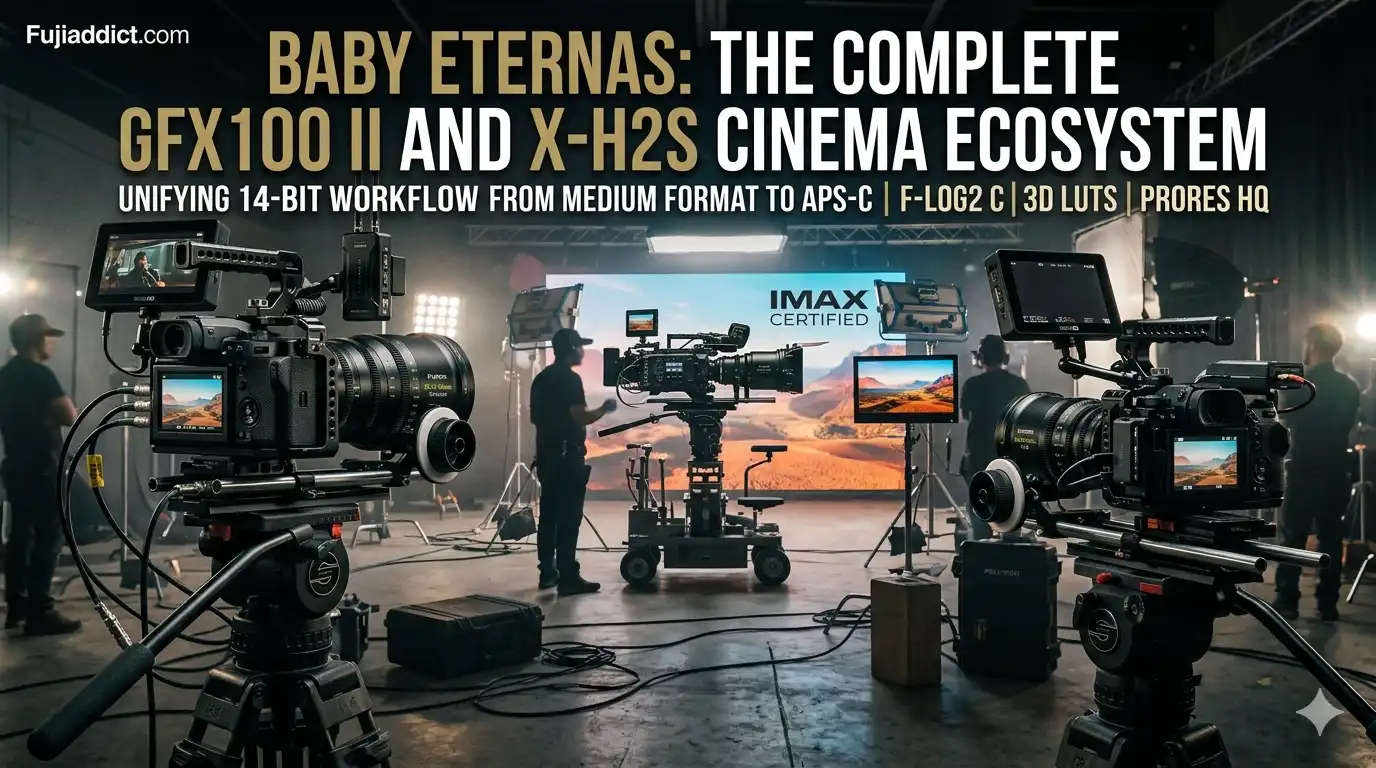
With the GFX Eterna 55 officially moving from development into production, the “Cinema Ecosystem” we have been piecing together across the G-mount and X-series is finally complete. While we’ve previously covered the individual milestones—from the initial F-Log2 C release to the arrival of the Eterna 3D LUTs—the release of Firmware Ver. 2.50 acts as the final technical bridge.
The GFX100 II and X-H2S have officially earned their title as “Baby Eternas.” Here is the full breakdown of why these two cameras are the only ones capable of delivering the IMAX-certified color science of their $16,000 big brother.
The reason the GFX100 II and X-H2S sit in a different class than the X-H2 or X-T5 comes down to the sensor architecture. Both cameras use Fujifilm’s Stacked BSI “HS” (High Speed) sensors—the same technology found in the Eterna 55.
This hardware allows for a 14-bit sensor readout in video. While the final files are recorded in 10-bit, the quality of the “source” data is significantly higher:
On the non-stacked X-H2, applying these LUTs to an F-Log2 C file often results in “thin” highlights or graying shadows because the LUT is essentially looking for 14-bit data that the 12-bit sensor never captured.
To maintain the “elasticity” of an IMAX-certified image, your choice of codec is just as important as your sensor. While both cameras offer H.265 (HEVC), the “Baby Eterna” workflow thrives on ProRes 422 HQ.
For any professional production where you intend to use the official Eterna LUTs, internal ProRes recording (ideally to an external SSD via the GFX100 II’s USB-C port) is the gold standard.
As we noted in our latest firmware coverage, the GFX100 II has moved beyond being a “stills camera that does video.” The addition of T-Stop displays, Wired Time Code Sync, and the Interactive Anamorphic Module (for correctly de-squeezing 1.33x, 1.5x, and 2x glass) provides the functional parity needed to sit alongside an Eterna 55 on a professional set.
Previous FujiAddict Coverage:
Fujifilm GFX100II:
B&H Photo / Amazon / Adorama
Fujifilm X-H2S:
B&H Photo / Amazon / Moment / Adorama
FUJIFILM GFX ETERNA 55:
B&H Photo / Amazon / Adorama