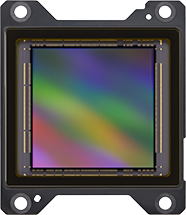
Whenever Sony Semiconductor Solutions (SSS) updates its industrial sensor catalog, Fujifilm watchers pay close attention. Because Sony fabricates the vast majority of Fujifilm’s X-Mount and GFX-Mount sensors, yesterday’s “industrial vision” silicon frequently becomes tomorrow’s flagship imaging pipeline.
Sony’s IMX927 and IMX937 series of stacked, back-illuminated (BSI) Pregius S Global Shutter sensors—headlined by a staggering 105.51-megapixel sensor capable of 100+ fps readout—is one of the most provocative releases on Sony’s semiconductor roadmap.
While a 105MP global shutter chip immediately sparks dreams of a future GFX100 III, a deeper dive into the specification sheet reveals a much more nuanced story. Because of its bit-depth ceiling, physical geometry, and massive data rates, this sensor family isn’t tailored for a traditional stills-first GFX flagship. Instead, it reads like the ultimate blueprint for a next-generation GFX Global Shutter Cinema Camera—or an entirely new class of 1:1 Square Multi-Format G-Mount camera that Fujifilm has never built before.
The product page doesn’t just detail a single chip; it outlines an entire scalable family of eight sensors across three optical sizes (Type 2.5, Type 2.0, and Type 1.8), split between ultra-high-speed (IMX92x), balanced-speed (IMX93x), and large-pixel ultra-high-sensitivity (IMX94x) tiers. All are offered in both Bayer color (-AQB) and monochrome (-AMB) variants.
| Model | Optical Size & Diagonal | Aspect Ratio & Dimensions | Effective Resolution | Pixel Pitch | All-Pixel Max FPS (8-bit / 10-bit / 12-bit) | Target Tier |
|---|---|---|---|---|---|---|
| IMX927 | Type 2.5 (39.7 mm) | 1:1 (~28.1 × 28.1 mm) | 105.51 MP (10,272 × 10,272) | 2.74 µm | 112 / 102 / 73 fps | Flagship 10.2K High-Speed |
| IMX937 | Type 2.5 (39.7 mm) | 1:1 (~28.1 × 28.1 mm) | 105.51 MP (10,272 × 10,272) | 2.74 µm | 56 / 51 / 36 fps | Balanced 10.2K Lower-Power |
| IMX947 | Type 2.5 (39.7 mm) | 1:1 (~28.1 × 28.1 mm) | 26.37 MP (5,136 × 5,136) | 5.48 µm | 423 / 383 / 277 fps | Pin-Compatible 5.1K Low-Light/HFR |
| IMX928 | Type 2.0 (31.9 mm) | 1:1 (~22.6 × 22.6 mm) | 68.16 MP (8,256 × 8,256) | 2.74 µm | 138 / 126 / 90 fps | 8.2K Square High-Speed |
| IMX938 | Type 2.0 (31.9 mm) | 1:1 (~22.6 × 22.6 mm) | 68.16 MP (8,256 × 8,256) | 2.74 µm | 70 / 64 / 45 fps | 8.2K Square Balanced |
| IMX929 | Type 1.8 (28.1 mm) | 4:3 (~22.5 × 16.9 mm) | 50.79 MP (8,224 × 6,176) | 2.74 µm | 225 / 201 / 136 fps | APS-C/S35 Class High-Speed |
| IMX939 | Type 1.8 (28.1 mm) | 4:3 (~22.5 × 16.9 mm) | 50.79 MP (8,224 × 6,176) | 2.74 µm | 115 / 102 / 69 fps | APS-C/S35 Class Balanced |
| IMX949 | Type 1.8 (28.1 mm) | 4:3 (~22.5 × 16.9 mm) | 12.69 MP (4,112 × 3,088) | 5.48 µm | 811 / 722 / 502 fps | S35 Ultra-Slow-Motion / Low-Light |
2.74 µm rings a bell, it should—that is the exact pixel pitch of Fujifilm’s 40MP X-Trans CMOS 5 HR sensor inside the X-H2, X-T5, X-T50, and X100VI. Sony has taken the pixel density of the X-H2, converted it to its Pregius S stacked BSI global shutter architecture, and scaled it up to a 105.5MP square array.The instinct that this sensor is far better suited for a cinema camera than a traditional stills-oriented GFX body is backed up by three core engineering realities: ADC bit-depth, sensor geometry, and readout physics.
The defining hallmark of the Fujifilm GFX100 II and GFX100S II is 16-bit RAW stills capture and class-leading 14+ stops of base ISO dynamic range. The IMX927/937/947 series tops out at a 12-bit ADC output (with 10-bit and 8-bit high-speed modes).
Look closely at the physical dimensions of the Type 2.5 sensor: it is a 28.1 × 28.1 mm square with a 39.7 mm diagonal.
Fujifilm’s GFX ETERNA 55 cinema camera relies on the 43.8 × 32.9 mm 102MP CMOS II HS rolling shutter sensor. While gorgeous for narrative pacing, reading out 102 megapixels on a traditional rolling shutter inevitably introduces skew during whip pans, action sequences, or handheld documentary work, and requires cropping or pixel binning to reach high frame rates.
Putting the IMX927, IMX937, or IMX947 into a G-Mount cinema body completely transforms what a GFX cinema system can do:
If Fujifilm tapped into the IMX927/937/947 ecosystem, it wouldn’t make sense to simply rehash an existing body. Here are three completely new cameras Fujifilm could pioneer with this silicon:
While the GFX ETERNA 55 serves the traditional shoulder-mounted/studio camcorder form factor, Fujifilm still lacks a compact, cube-style Box Cinema Camera (akin to the RED V-Raptor, ARRI Alexa Mini LF, or Sony Venice Rialto) built for gimbals, drones, Steadicams, and multi-cam arrays.
Because the 105MP IMX937 and the 26.4MP IMX947 are 100% pin-compatible, Fujifilm could engineer a single compact G-Mount cube chassis (keeping the ETERNA’s internal electronic variable ND filter) and offer it in two distinct flavors—or with user/service-swappable sensor blocks:
Fujifilm has a storied heritage in 6×6 square medium format (most notably the folding GF670 and modular GX680), yet no camera manufacturer today builds a dedicated 1:1 Square Digital Medium Format Camera.
Using the IMX937, Fujifilm could build a compact, waist-level-finder modular G-Mount camera:
Fujifilm already develops specialized industrial imaging systems (such as the GFX100 IR and SX-series surveillance cameras), while Phase One dominates high-end aerial mapping and drone inspection. A ruggedized, shutterless G-Mount industrial camera built around the IMX927—including a Monochrome (IMX927-AMB) edition—would allow high-speed aerial surveying, cultural heritage digitization, and 3D photogrammetry at 73 to 100 fps with zero mechanical shutter wear and zero motion distortion.
Before closing out that Sony spec sheet, X-Mount shooters should look closely at the bottom rows of the table: the IMX929 and IMX939.
Those two chips feature a 28.1 mm diagonal (virtually identical to X-Mount’s ~28.3 mm APS-C diagonal), a 50.79-megapixel resolution (in a slightly taller 4:3 cut), and the exact 2.74 µm pixel pitch of the 40MP X-H2—delivering 69 fps (IMX939) to 136 fps (IMX929) at 12-bit with a Pregius S Global Shutter. Trim that 4:3 array down to a standard 3:2 APS-C aspect ratio, and you are looking at a ~40MP APS-C Global Shutter sensor.
Whether Sony’s IMX927/947 family first surfaces in a GFX ETERNA Global Shutter Box Cinema Camera, or its 2.74 µm Pregius S pixel architecture trickles directly into a future Fujifilm X-H3, Sony has officially solved the resolution-versus-speed equation for global shutter sensors. Now the ball is in Fujifilm’s court—and if X-Processor 6 is built to handle SLVS-EC bandwidth at this scale, the next generation of G-Mount and X-Mount video is going to be extraordinary.
via sony-semicon